


If you’ve been around an acupuncture classroom for more than five minutes, you’ve probably heard someone mention the legendary “Four Gates.”
If not… you will. Trust me.
This dynamic duo pairs two superstar points: Large Intestine 4 (LI4) and Liver 3 (LV3).
Together, they’re the ultimate Qi-moving team — like the acupuncture world’s version of Batman and Robin.
LI-4 is one half of this classic combination. For a closer look at the point on its own, see LI-4 Acupuncture Point.
Why Clinicians Love This Combo
You’ll see this pairing everywhere in clinic because it’s that effective. The Four Gates are famous for their ability to move Qi and Blood throughout the body, making them a go-to for pain, stress, and stagnation of all kinds.
Think:
-
Tense shoulders from stress
-
Frustration that bubbles over into headaches
-
Menstrual cramps from Liver Qi stagnation
-
Pretty much any case that screams “things aren’t moving!”
When your patient’s Qi flow feels stuck — emotionally, physically, or both — the Four Gates are a fantastic choice.
Want the Full List? LI4 & LV3 are just 2 of the Top 10
I've put together a free guide covering all 10 essential Acupuncture points every practitioner needs to know — including clinical actions, key combinations, and location tips for each one.
Yes, Send Me the Free Guide →100% free — no spam, unsubscribe anytime
When to Reach for the Four Gates
Clinical decision-making is one of the things that separates a confident practitioner from one who’s still second-guessing every treatment. Here’s a simple way to think about Four Gates:
If your pattern diagnosis involves any of the following, the Four Gates deserve serious consideration:
- Liver Qi Stagnation (classic case of when to use the four gates)
- Qi and Blood Stagnation anywhere in the body (related to pain – see below)
- Emotional constraint — frustration, irritability, pent-up stress, frequent sighing
- Pain with a strong stagnation component
- Cases with both physical and emotional dimensions (which is most of them, honestly)
You’ll also find them useful as an “opener”. Many practitioners needle Four Gates first to get Qi moving, then layer in more targeted points. Think of it as clearing the highway before you start directing traffic. There are many different systems of acupuncture which utilize these concepts. Over the years, I’ve become less dependent on these concepts but I still find them interesting.
Clinical Indications — What the Four Gates Actually Treat
Let’s be more specific than “moves Qi and Blood” (though that does cover a lot of ground). Here’s a broader picture of what Four Gates addresses clinically:
- Stress! Which often manifests as the symptoms below.
- Headaches and migraines — especially tension and stress-related
- Menstrual irregularities, dysmenorrhea, PMS
- Musculoskeletal pain, especially when driven by stagnation rather than deficiency
- Anxiety, irritability, emotional depression
- Digestive issues tied to stress (IBS, bloating, constipation from Liver invading Spleen)
- Hypertension (emerging research support, especially involving LV3)
- Insomnia – when Liver Qi is involved
Same Structure, Different Limbs
Here’s something fun: anatomically, LI4 and LV3 are practically twins — just on opposite ends of the body.
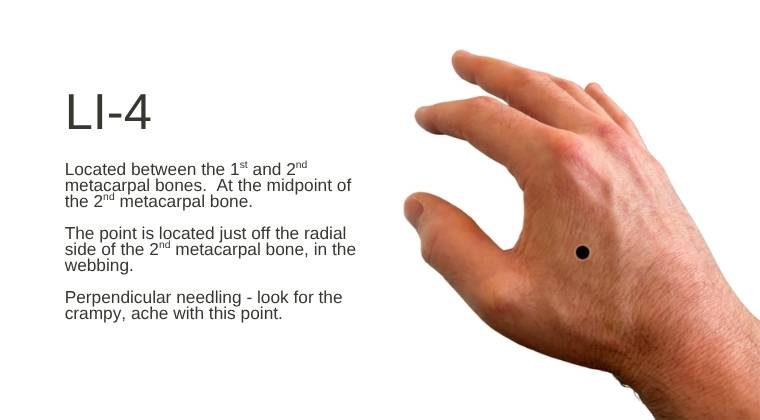
LI4 is located between the 1st and 2nd metacarpal bones of the hand.
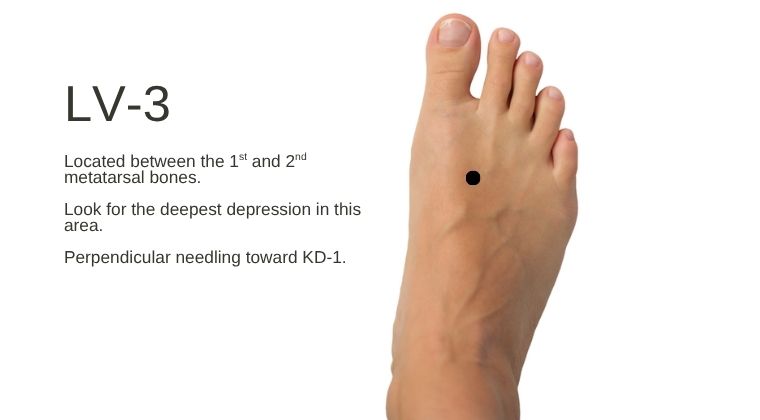
LV3 is between the 1st and 2nd metatarsal bones of the foot.
It’s a lovely bit of TCM symmetry — a hand-foot balance that echoes the harmonizing effect this combo has on the whole system.
What Modern Research Is Saying
From a Western perspective, LI4 has real evidence behind its pain-relief reputation: one small trial found electroacupuncture at LI4 kept plasma β-endorphin levels steady over 30 minutes while a sham-treatment group saw levels drop — consistent with a genuine opioid-pathway effect (Setiawardhani et al., 2017).
Meanwhile, LV3 interacts with the deep peroneal nerve and dorsalis pedis artery, influencing peripheral circulation and helping move blood through the system (more on LV3 below).
So, when you put these two points together, you get a combo that relieves pain, promotes circulation, and does exactly what the classics say: moves Qi and Blood, stops pain.
New Research Directions
Recent studies are shining more light on LV3, especially in the treatment of hypertension — a common issue you’ll see in clinic. For those who have treated people with hypertension, you’ve likely noticed the often strong connection with the TCM Liver and the typical symptoms of high blood pressure (headaches, red eyes/face, irritability etc.).
One study worth knowing about looked at Four Gates specifically for Alzheimer’s disease. Ji et al. (2021), publishing in Neural Plasticity, gave 14 Alzheimer’s patients and 14 healthy controls a brief acupuncture session at LI4 and LR3 while scanning their brains before and after. The result was genuinely interesting: healthy brains and Alzheimer’s brains responded differently. In healthy participants, several major brain networks showed reduced connectivity after treatment. In the Alzheimer’s group, the pattern was more selective — some regions showed reduced connectivity, others showed increased connectivity, which the researchers describe as a possible sign of the brain compensating for disease-related damage rather than a uniform effect.
It’s a small, early study — 12 patients per group after exclusions, single session, no placebo-needle control — so this isn’t proof Four Gates treats Alzheimer’s. But it’s a real, published signal that this combination affects brain network activity differently depending on the health of the brain receiving it, which is a genuinely novel angle beyond the usual “moves Qi and Blood” framing.
Bringing It All Together
You’ll use the Four Gates combo a lot in practice. Not every patient needs it, of course, but when you’re aiming to “get things moving,” this pair rarely disappoints.
And before you start needling, make sure your point location is on point — both LI4 and LV3 have common pitfalls. (Check out my videos on my YouTube channel – LI4 and LV3
Important Contraindications
This section could save you from a serious mistake.
LI4 is contraindicated during pregnancy. Full stop.
LI4 has a powerful descending and moving action — which is exactly what makes it so effective for pain, constipation, and even labor induction. But that same action makes it inappropriate during pregnancy, where you absolutely do not want to be driving Qi downward.
LV3 is generally considered safe during pregnancy on its own, but when paired with LI4 — amplifying that descending, moving quality — the combination as a whole should be avoided.
When in doubt: if your patient is pregnant, skip LI4.
A few other things worth keeping in mind:
- Qi and Blood deficiency: Four Gates can feel quite draining in patients with significant deficiency. Use lighter stimulation or consider whether moving is the right approach before there’s enough Qi to move.
- Hypotension: LI4 can lower blood pressure — helpful for hypertension, but something to be aware of in patients who already run low.
- Elderly or weak patients: Go lighter on stimulation. The effect is still there; you don’t need to chase a strong De Qi response in every patient.
Needling Tips
Both LI4 and LV3 can be sensitive points — patients new to acupuncture often find them more intense than they expected. A little heads-up goes a long way.
LI4: Needle perpendicularly, 0.5–1 cun. You’re aiming for a strong De Qi sensation (which is very easy to get!) — that achy, crampy feeling that makes clients eyes open wide – I know it sounds rough but this sensation is what we need for it to work. Avoid deep needling toward the metacarpal bone. Check out my YouTube video on the location of this popular point
LV3: Needle perpendicularly or slightly obliquely toward the ankle, 0.5–1 cun. This point also surprises a lot of patients. Prepare them for a stronger sensation than they might expect at a “foot point.” I have a YouTube video on LV-3 as well.
A word on De Qi: with the Four Gates, you generally want it. The whole point of this combination is to move stagnation — a clear De Qi response is your confirmation that things are being activated. That said, read your patient. Chasing needles sensation in an anxious first-timer is rarely worth it.
Frequently Asked Questions
LI4 & LV3 are Just the Start — Get the Full Top 10
These two points are powerful on their own — but the complete Top 10 list will give you a rock-solid foundation for treating the vast majority of what walks through your door.
100% free — no spam, unsubscribe anytime

References
Ji, S., Zhang, H., Qin, W., Liu, M., Zheng, W., Han, Y., Song, H., Li, K., Lu, J., & Wang, Z. (2021). Effect of Acupuncture Stimulation of Hegu (LI4) and Taichong (LR3) on the Resting-State Networks in Alzheimer’s Disease: Beyond the Default Mode Network. Neural Plasticity, 2021, 8876873. https://doi.org/10.1155/2021/8876873
Setiawardhani, A. L., Srilestari, A., & Simadibrata, C. (2017). Electroacupuncture effect at the LI4 Hegu point on the plasma β-endorphin level of healthy subjects. Journal of Physics: Conference Series, 884, 012027. https://doi.org/10.1088/1742-6596/884/1/012027