


Auricular Acupuncture — the practice of stimulating specific points on the ear to affect the rest of the body — has become one of the most versatile tools in a practitioner’s toolkit. Whether you’re treating anxiety, pain, digestive complaints, or sleep issues, there’s very likely an ear point that can support your treatment plan.
Below, you’ll find a practical reference to the most commonly used auricular points in an acupuncture clinic setting, along with the treatment options and clinical decision-making that go into using these tools effectively.
Key Auricular Points and Their Functions
While a full auricular map contains hundreds of points, a handful come up again and again in clinical practice. Here are some of the most frequently used:
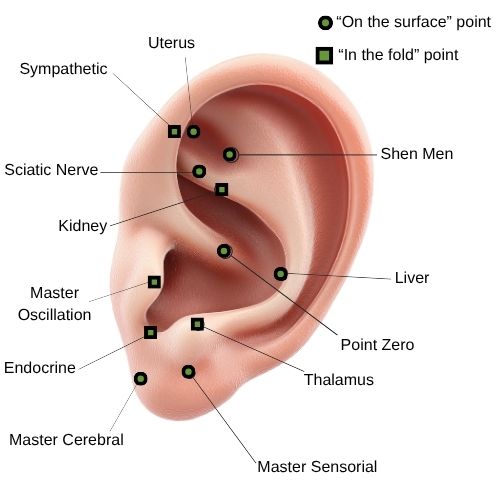
Shen Men (“Spirit Gate”) Located in the upper portion of the ear, within the triangular fossa (look for the “eye” of the fish head!). One of the most widely used points in auricular practice, valued for calming the mind and reducing stress, anxiety, pain and general nervous tension.
Point Zero Found on the middle of the root of the helix – not quite in the concha. Often considered a foundational or “reset” point, used to help balance the body’s overall energy before or alongside other point selections.
Master Sensorial (Sensorial Point) Located on the ear lobe, slightly superior to where a typical ear piercing may be. Associated with sensory and cognitive function, and often included in protocols addressing focus, clarity, or sensory processing.
Kidney Point Located in the fold under the inferior crus in the superior aspect of the superior conch, angled towards the top of the head. In TCM terms, it is tied to the Kidney’s role in vitality, fear, and the body’s foundational energy — commonly used for lower back pain, fatigue, fertility issues and constitutional weakness.
Liver Point Found by following the root of the helix towards the wall of the concha. Associated with the Liver’s role in the smooth flow of Qi — useful for stress, irritability, menstrual concerns, and musculoskeletal tension.
Sciatic Nerve The one that started a lot of the interest in auricular therapy! Historically, the point was cauterized to relieve sciatic nerve pain. Located on the cartilaginous aspect of the inferior crus.
Uterus Point Frequently used in gynecological and fertility-related treatment, particularly for menstrual pain and irregularity. Found in the triangular fossa, towards the wall of the helix.
This is far from a complete list — the ear contains points corresponding to nearly every organ system and many musculoskeletal areas — but these represent some of the most clinically useful starting points for practitioners newer to auricular work.
Important: The circle marks a surface point — located directly on the visible surface of the ear, straightforward to access. The square marks a fold point — tucked behind a fold or crevice of the ear’s structure, not visible from the outside. These points take more care to needle correctly: you’ll often need to gently move or open the ear to reach the spot, and since you can’t see exactly where the needle is entering, placement relies more on feel than sight.
Clinically Common Auricular Points
“Homunculus” or Inverted Fetus
Want These Points On Hand, Every Time?
Download Auricular Acupuncture Essentials — a free reference guide covering ear anatomy, the points you'll use most, the NADA protocol, and ready-to-use combinations for pain, stress, and menstrual complaints.
Get the Free Guide →Instant download. No spam, ever.
What Can Auricular Acupuncture Treat?
Honestly, almost anything. Whether you’re treating anxiety, sleep problems, menstrual concerns, or shoulder pain, there’s very likely an appropriate ear point to incorporate. Auricular acupuncture works well as a complement to full-body treatment — adding one or two well-chosen ear points to a body acupuncture protocol, rather than replacing it.
Some practitioners may only use auricular treatments but I can’t say that this type of treatment would be effective for all health concerns. Think of auricular therapy as a complement to your regular acupuncture treatments – not something that should be done on its own.
Choosing Your Points Based on TCM Diagnosis
Even without memorizing the full auricular map, you can build effective ear point prescriptions directly from a TCM diagnosis:
- Menstrual pain due to Liver Qi stagnation → Liver point + Uterus point
- Kidney Yang deficiency with back pain → Kidney point + lower back area of the ear
- Heart Yin deficiency with anxiety → Heart point + Sympathetic + Shen Men
This diagnosis-first approach means you don’t need to be an auricular specialist to start incorporating these points effectively — a solid grasp of a handful of key points, paired with your existing TCM diagnostic skills, goes a long way.
Remember, you can combine the Eastern and Western philosophies with auricular medicine. As you can see above, the Heart Yin deficiency with anxiety picture has the Heart (TCM), sympathetic point (Western) and Shen Men (TCM). Take full advantage of the fact that there are two interesting understandings of points in the ear. Terry Oleson’s charts make these points clear with a “C” indicating the Chinese TCM points and the “E” for the European/Western points. More on this below.
Treatment Options: Choosing Your Stimulation Method
There are several ways to stimulate auricular points, each with its own advantages and considerations.
Ear Seeds
Ear seeds are an extremely safe, simple way to stimulate ear points. The major advantage: clients go home with them in place and can press the seeds themselves whenever they need to.
Leave ear seeds in for around a week (sometimes longer). Clean the area well with 70% alcohol and make sure the skin is fully dry before applying — this helps the seeds stay adhered.
The one drawback: seeds may not provide strong enough stimulation for certain areas, like the helix or lobe. The goal is for the patient to actually feel something when they press — if they can’t, the seeds likely aren’t doing much.
Intradermal Tacks
Tacks provide a stimulation upgrade over seeds, since they actually pierce the skin.
A few practical considerations:
- Don’t leave tacks in for more than a couple of days — infection risk increases the longer they stay in
- Dispose of tacks in a sharps container; if a client doesn’t have one on hand, you may need to remove and dispose of the tack yourself at a follow-up visit
- Never press a tack with your finger on the opposite side of the ear — this risks a needle-stick injury
- Choose an appropriate tack length for the area you’re treating; many styles are available
Needles
Standard acupuncture needles remain the most common way to stimulate ear points. With a steady hand, needle placement can be highly precise, and stimulation is easily noticeable for most clients.
The key technical point: needles need to be inserted enough to be properly “rooted” — meaning there’s no wobble when touched. An unrooted needle is far more likely to fall out with normal movement (talking, jaw motion, etc.).
Electro-Stimulation
Electrical stimulation — via a point-detector pen, an e-stim acupuncture machine, or a TENS unit — is an increasingly common auricular option. Many practitioners believe this stimulation affects the vagus nerve, the longest nerve in the body, running from the ear down to the lower abdomen. A growing body of research has explored vagus nerve stimulation via the ear for conditions like anxiety, depression, insomnia, and digestive concerns.
Four Steps to Better Auricular Treatments
- Know your ear anatomy. Having a clear anatomical reference makes point location significantly easier.
- Learn the main organ points and master points first. Understand where they are and why you’d use each one before expanding further.
- Match your stimulation technique to the patient. Ear seeds for lower sensitivity or at-home follow-up; needles or tacks for a stronger, in-clinic effect. Base this choice on your patient’s anxiety and sensitivity levels.
- Pay attention to patient feedback. Sensation should be noticeable but comfortable. If ear seeds or tacks become painful, they should be removed, and the area should be cleaned well.
A Brief History
Auricular acupuncture as it’s practiced today owes much of its formalization to Dr. Paul Nogier, a French neurologist working in the 1950s and 60s. Nogier’s interest was sparked after observing patients who’d had a specific point on the ear cauterized by a local healer for sciatic pain — a technique with roots in traditional Chinese medicine. Nogier took this observation and developed it into the structured auricular system that’s since spread worldwide and been further refined by both Western and Chinese practitioners.
Two Systems: Chinese Model vs. European (French) Model
If you dig into auricular acupuncture literature, you’ll notice point names and locations don’t always match perfectly between sources. That’s because there are really two distinct traditions at play, built on different underlying logic.
The Chinese model ties auricular points to TCM organ systems and meridian theory — a Kidney point relates to Kidney function, a Liver point relates to the Liver’s role in the smooth flow of Qi, and so on. This is the framework behind most of the points covered earlier in this guide.
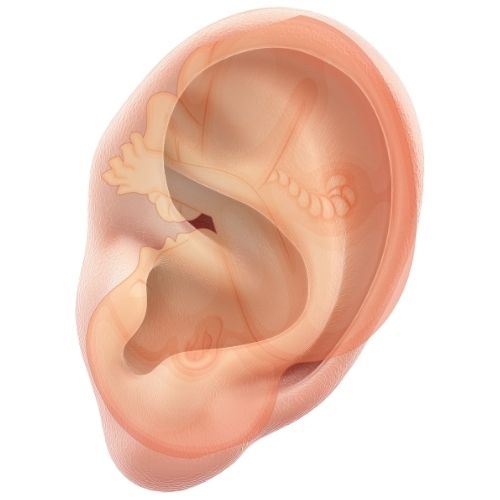
The European (French) model, developed by Dr. Paul Nogier, is built on a different organizing principle entirely: somatotopic mapping. Rather than organ correspondence, the ear is treated as a miniature representation of the whole body — often described as an inverted fetus. Picture a fetus curled up inside the ear: the head and face map to the lobe, the spine follows the curve of the antihelix, and the limbs and feet extend up toward the top of the ear (the helix). This “homunculus” concept is why European-model points are named for body regions and neurological structures (Master Sensorial, Thalamus, Master Cerebral) rather than internal organs.
As mentioned before, most modern practitioners draw from both systems rather than sticking rigidly to one — which is part of why you’ll see some overlap and some variation in point charts depending on the source.
10 Widely-Used Points Across Both Systems
Here’s a broader reference list, drawing from both the Chinese and European traditions:
- Shen Men (“Spirit Gate”) — Upper ear, within the triangular fossa (the “fish eye”!. Calms the mind; used for anxiety and stress.
- Point Zero — Found on the middle of the root of the helix. A foundational “reset” point, often used to balance overall energy before other point selections.
- Master Sensorial — In the lobe of the ear – close to where you might get a piercing. Supports sensory processing, focus, and clarity.
- Master Cerebral (Subcortex) — Located inferiorly to the intertragic notch, on the anterior lobe. Associated with cognitive and emotional regulation, often used for stress and cognitive fog.
- Endocrine Point — Located in the intertragic notch area. Associated with hormonal balance; commonly used in fertility and menstrual-related protocols.
- Thalamus Point — Located near the anti-tragus. Associated with pain modulation and relay of sensory information — frequently used in pain management protocols.
- Sympathetic/Autonomic Point — Located on the wall of the helix in line with the superior border of the inferior crus. Supports nervous system regulation and relaxation.
- Master Oscillation — Associated with regulating rhythm and balance in the body’s systems.
- Kidney Point — Tied to vitality, fear, and foundational energy in TCM terms.
- Liver Point — Tied to the smooth flow of Qi; used for stress, irritability, and menstrual concerns.
(A detailed point chart with exact locations for each of these is provided above.)
Individualized Selection vs. Standardized Protocols
Everything covered so far in this guide is about individualized point selection — building a custom combination of points based on a patient’s specific TCM diagnosis or presentation. This is the flexible, case-by-case approach most practitioners use day to day.
There’s also a different approach: standardized protocols, where the same fixed set of points is used for every patient, regardless of individual presentation. The best-known example is the NADA protocol — a specific 5-point combination (Sympathetic, Shen Men, Kidney, Liver, Lung) originally developed for addiction treatment and now used broadly in mental health and crisis-response settings. If you’re looking for that specific protocol in detail — including exact needling order and technique — see our full guide to the NADA protocol.
Bringing It Into Your Practice
Auricular points are one of the most flexible additions you can make to almost any treatment protocol. Combine a well-chosen ear point or two with a solid body-acupuncture point selection, and you have a genuinely well-rounded treatment.
Want These Points On Hand, Every Time?
Download Auricular Acupuncture Essentials — a free reference guide covering ear anatomy, the points you'll use most, the NADA protocol, and ready-to-use combinations for pain, stress, and menstrual complaints.
Get the Free Guide →Instant download. No spam, ever.
What is Auricular Acupuncture, and How Does it Work?
- Question: What exactly is auricular acupuncture, and how does it differ from traditional acupuncture?
- Answer: Auricular acupuncture is a specialized form of acupuncture that focuses on stimulating points on the ear to promote healing and balance throughout the body. In this technique, specific points on the ear correspond to different organs, systems, and functions of the body. By stimulating these points with needles, seeds, or ear pellets, practitioners aim to address various health conditions and restore overall well-being.
What Conditions Can Auricular Acupuncture Treat?
- Question: What are some common conditions that auricular acupuncture can help treat?
- Answer: Auricular acupuncture has been used to address a wide range of physical, emotional, and psychological conditions. Some common applications include pain management, stress reduction, addiction recovery, insomnia, anxiety, and digestive disorders. Research suggests that stimulating specific points on the ear can influence corresponding areas of the body and promote healing and balance in various systems.
Is Auricular Acupuncture Safe and Suitable for Everyone?
- Question: Is auricular acupuncture safe, and who can benefit from this treatment modality?
- Answer: Auricular acupuncture is generally considered safe when performed by a qualified practitioner. However, like any form of acupuncture, it may not be suitable for everyone, particularly those with certain medical conditions or sensitivities to needles. It’s essential to consult with a licensed acupuncturist to determine if auricular acupuncture is appropriate for your individual needs and health status. Additionally, pregnant women should seek guidance from their healthcare provider before undergoing any acupuncture treatment.