
If you’ve spent any time around auricular acupuncture, you’ve likely come across the NADA protocol — a standardized, 5-point ear acupuncture technique originally developed for addiction treatment and now used far more broadly, including in trauma care, mental health settings, and disaster/crisis response.
I’m here to help you understand what this protocol is all about, the five points involved, and what to know if you’re incorporating it into your own practice.
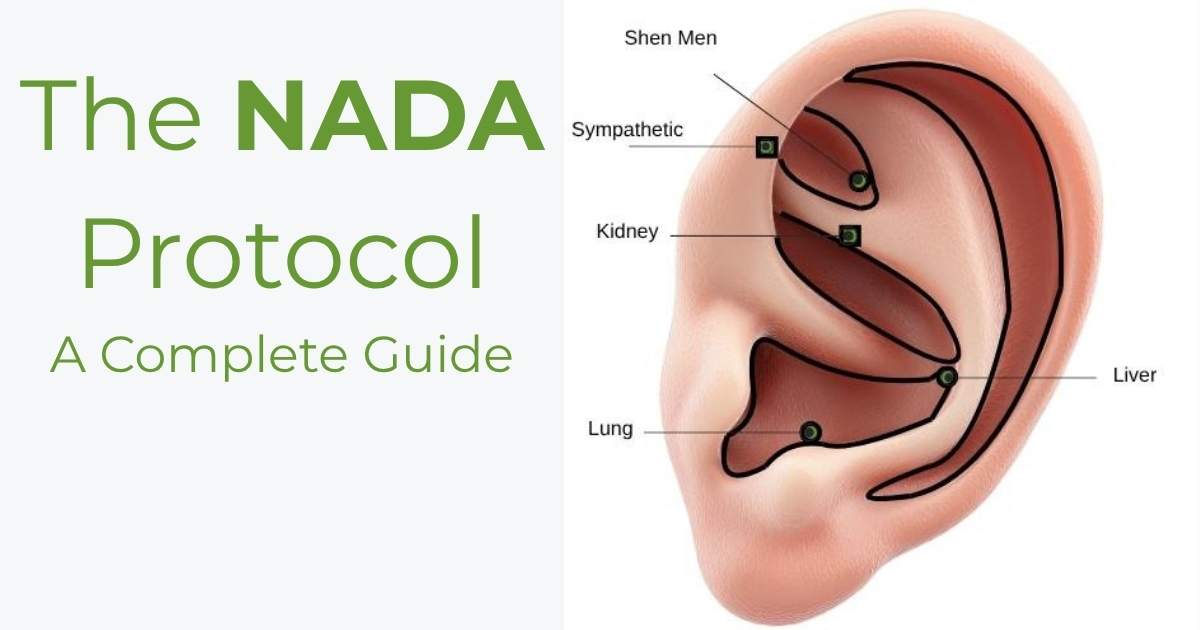
I completed my NADA training in 2007 at a hospital addiction centre in Toronto, Canada (St. Joseph’s Hospital). I was extremely interested in auricular acupuncture at the time and the location was literally around the corner from my apartment. I now use auricular therapy in nearly every treatment I do.
What Is the NADA Protocol?
NADA stands for the National Acupuncture Detoxification Association, the organization that developed and standardized this specific 5-point ear acupuncture protocol. It originated from work by an anesthetist in Hong Kong treating opioid and cocaine dependence in the 1970’s, and was later formalized in the United States as a structured, teachable protocol — notably used in group settings, addiction treatment centers, and hospitals.
What makes NADA distinct from general auricular acupuncture is its standardization: the same five points are used regardless of the individual’s specific presentation, making it accessible to train and deliver consistently across many practitioners and settings.
The 5 NADA Points
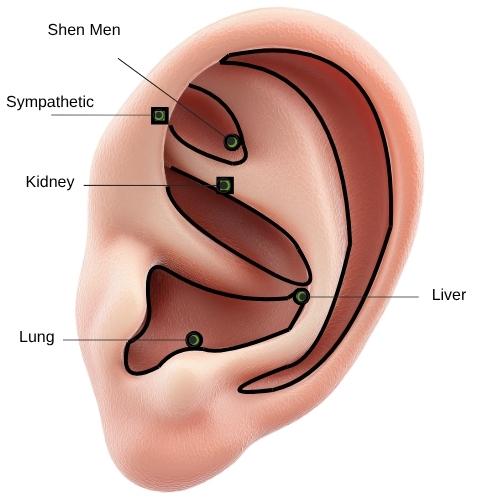
The NADA protocol uses five specific points, all located in the ear:
- Sympathetic — Supports the balancing of the sympathetic nervous system and helps encourage relaxation.
- Shen Men (“Spirit Gate”) — Used broadly for calming the mind, reducing anxiety, reducing pain, and supporting emotional regulation.
- Kidney — Balances fear response, hormonal function, and encourages strong willpower.
- Liver — Associated with the smooth flow of Qi, emotional regulation, and detoxification support.
- Lung — Tied to grief and the body’s process of “letting go,” and traditionally associated with detoxification and respiratory support.
Together, these five points form a complete, self-contained protocol — no additional diagnosis or point customization is required, which is part of what makes NADA so widely teachable and deliverable in group or high-volume settings.
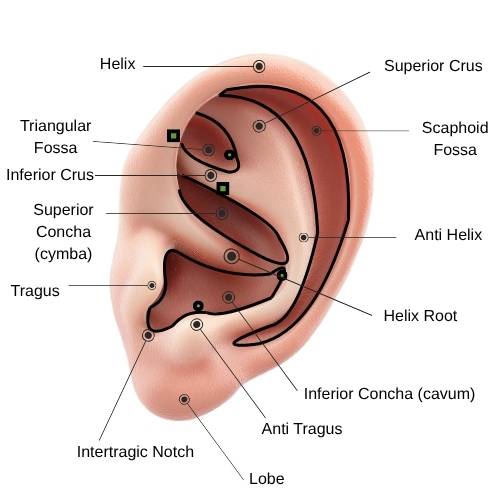
Point Location Reference
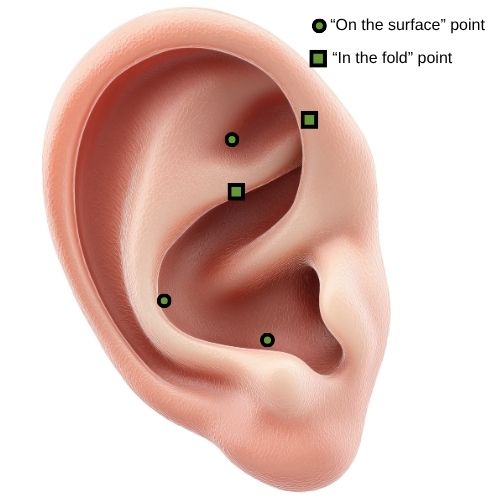
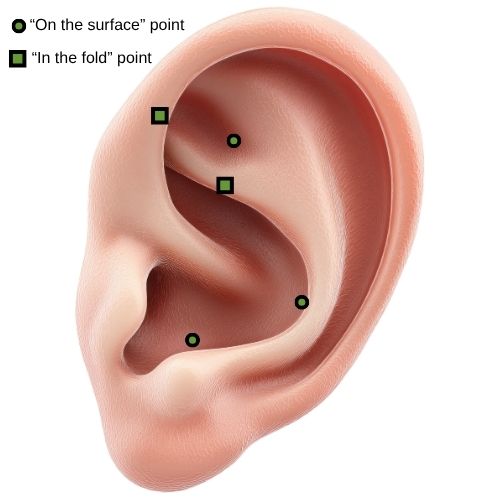
The chart below shows all five NADA points. Since some points sit within the folds of the ear rather than on a flat, visible surface, points are marked two ways:
● On the surface point — marked with a circle and typically visible on the outer surface of the ear – often needled perpendicularly
■ In the fold point — marked with a square and located within a fold or crevice, not directly on the visible surface (an angled needle is necessary to reach these points)
A mirrored version of the chart is also provided for the opposite ear, since translating point location from one side to the other can be a common sticking point for students.
Point placement can vary slightly depending on the source. The locations shown here are based on NADA’s own training materials alongside other established auricular references, including Terry Oleson’s work.
How the Protocol Is Delivered
NADA is most commonly delivered in a group, seated setting — patients sit together, needles are placed bilaterally (both ears) at all five points, and the group rests quietly together for the duration of treatment, usually around 45 minutes. This group format is part of what makes NADA especially practical for addiction treatment centers, community mental health programs, and crisis response settings.
Want These Points On Hand, Every Time?
Download Auricular Acupuncture Essentials — a free reference guide covering ear anatomy, the points you'll use most, the NADA protocol, and ready-to-use combinations for pain, stress, and menstrual complaints.
Get the Free Guide →Instant download. No spam, ever.
Practical Technique Notes
A few things worth knowing if you’re delivering NADA in practice:
Needle rooting matters — a lot. Because patients are typically seated (not lying down), and although talking or interaction during treatment is discouraged, unrooted needles can easily fall out with normal jaw movement – even just smiling. Make sure each needle is properly rooted — there should be no loose wobble once the needle is inserted.
Needle choice: half-cun or one-cun needles are standard. Anything longer becomes too heavy for the ear and is more likely to work its way loose.
Watch for bleeding. The ear bleeds easily. Keep a Q-tip on hand to manage any small drops that come up during needle placement or removal.
Effects can outlast the treatment. Since needles come out before the patient leaves, active stimulation stops at the end of the session — but due to the strength of the stimulation, treatment effects are often reported as long-lasting even after the needles are removed.
Location Tips & Needling Order
The order that you needle these points in is very important — not because it has clinical significance, but more because needles will get in your way if you don’t do them in the correct order.
Sympathetic: This point is ideally needled first. It is angled to go behind the fold of the helix and is one of the “in the fold” points. Most sources mention following the superior edge of the inferior crus for proper point placement. Because this point is “blind” (you can’t see the needle tip enter the skin), you need to needle this point based on feel. The common mistake is that people stop the insertion process too early because they either feel the resistance of the skin or they may see their patient wince a little. Make sure you get some depth with this point, as it is commonly one that isn’t rooted enough to stay in for the duration of the treatment.
Shen Men: This point is often needled second. Since this point is an “on the surface” point, it can simply be needled perpendicularly and is the easiest one to do. One of my TCM practitioners once told me, “Look for the eye of the fish with Shen Men.” Take a look at the images provided above and note that Shen Men is right where the eye would be on the fish head that’s outlined by the triangular fossa.
Kidney: This point is often needled third. As another one of the “in the fold” points, needle angulation is required, aiming superiorly toward the top of the head. When you’re finished needling this point, the needle handle may be very close to the anti-tragus if you have the angle done correctly. Again, you’re going in a little “blind” with this point, so make sure you’re inserting enough for the needle to stay rooted.
Liver: This point is often needled fourth. Although this point is still considered an “on the surface” point, sometimes the anti-helix is curved enough to make this point a little hidden as well — it just depends on the individual’s anatomy. Angle your needle appropriately to ensure you’re connecting with the right spot. Follow the root of the helix until you reach the wall of the concha, and you’ll be on the Liver point area.
Lung: This point is typically needled last. In my opinion, this is the pinchiest of all these points (worth a mention if you’re with a sensitive client). This point can be a little confusing, as there are two lung points to consider — you want the more inferior Lung point for the NADA protocol. I use the tragus as a guide and basically have my needle shaft on top of the tragus, then go in with perpendicular insertion. This will get you that lower Lung point and will keep you from being too far anterior or posterior. Similar to the Liver point, depending on the anatomy of the tragus, you may need to be a little more angled to go behind the tragus to hit this spot. Some sources may even consider this an “in the fold” point.
Who Uses NADA?
While it was developed specifically for addiction treatment, NADA has since expanded into:
- Mental health and trauma-informed care settings
- Disaster and crisis response (used in various community response efforts)
- General stress and anxiety support programs
- Correctional and community health settings
Its accessibility — no complex diagnosis required, deliverable in a group format, minimal training barrier — has made it one of the most widely adopted standardized acupuncture protocols in community and public health settings.
Learning More
If you’re interested in incorporating NADA into your practice, formal NADA training and certification is available through NADA-affiliated training programs. For a broader look at how auricular points function outside the standardized NADA protocol — including how to select points based on individual TCM diagnosis — see our full guide to auricular acupuncture.