
If SP6 is the Swiss Army knife of the lower body, PC6 is the point every acupuncturist reaches for above the waist — nausea, anxiety, palpitations, chest tightness, insomnia. Almost nothing else in the point catalogue has this kind of range across both physical and emotional presentations.
Neiguan. Inner Gate. And that name isn’t decorative — it describes exactly what this point does: it opens a gateway between the chest and the outside world, regulating what moves in and out of the body’s emotional and physical “engine room.”
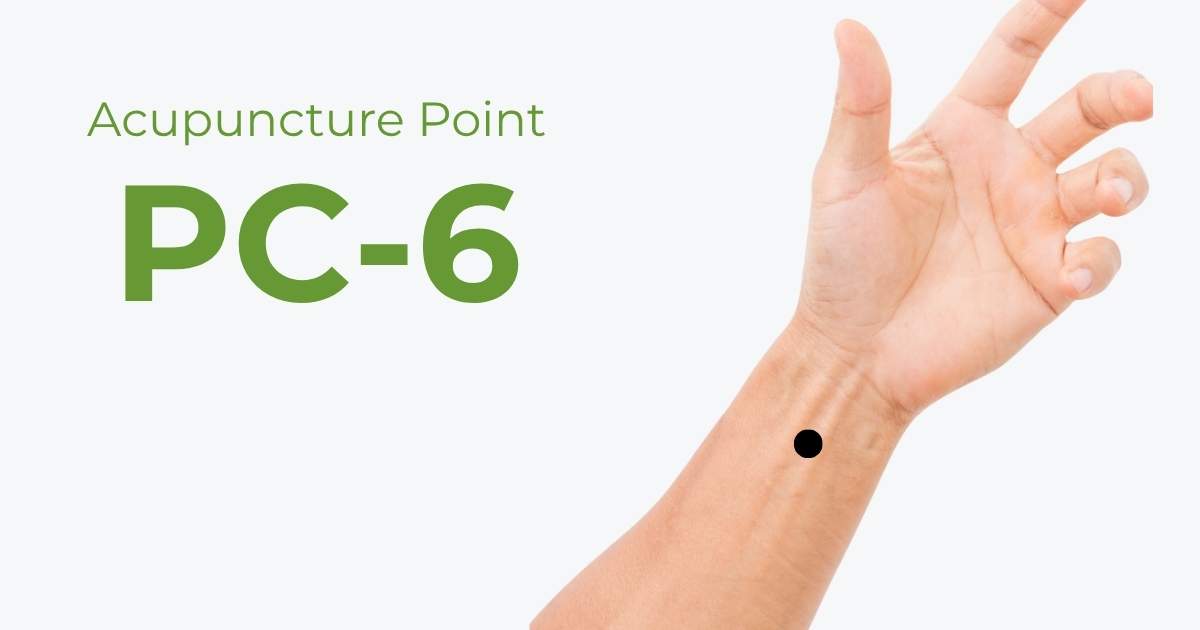

Here’s something worth knowing before we go further: PC6 might be the single most publicly recognized acupuncture point on earth, even among people who’ve never had acupuncture. More on that shortly. First, let’s make sure you know exactly where to find it.
| Point Name | Neiguan — "Inner Gate" |
| Channel | Pericardium (Hand Jueyin) |
| Point Number | PC6 |
| Point Type | Luo-Connecting point; Master point of the Yin Wei Mai (Yin Linking Vessel) |
| Element | Fire (Pericardium is paired with Triple Burner) |
| Location | 2 cun proximal to the wrist crease, between the tendons of palmaris longus and flexor carpi radialis |
Anatomy: How to Actually Find This Point
PC6 sits on the palmer-side of the forearm, and the landmarks here are often helpful (if you can see them!) — however, this is a point students tend to find quickly and confidently once they know what they’re feeling for.
Starting point: the transverse wrist crease (look for the most distal and dominant crease), in between the flexor carpi radialis and palmaris longus tendons – often the two visible tendons in this area. Measure 2 cun proximal (toward the elbow) from the crease — roughly the width of the index and middle finger of the patient’s own finger-widths (see image). However, for those in TCM or Acupuncture school – use your 12 cun measurement from the wrist crease to the cubital crease (elbow crease) and measure down from there.
Locating the tendons: ask the patient to make a light fist and flex the wrist slightly against resistance — you’ll see two tendons stand up clearly under the skin: palmaris longus (more superficial and central) and flexor carpi radialis (slightly more radial/thumb-side). PC6 sits directly between them. Not everyone has a palmaris longus tendon (it’s congenitally absent in a meaningful percentage of people) — if you can’t find it, use flexor carpi radialis and the midline of the forearm as your reference instead.
Patient positioning: ideally laying down supine or prone. If supine (face up), the arm can either lay supinated on the patient’s abdomen (palm facing the head) or lay their arms at their side – (*just make sure the table is wide enough to accommodate this as there is nothing worse than the feeling of your arm slipping off the table when there are needles in it). If prone (face down), needling PC-6 becomes even easier as long as the arm is at their side. Some patients get a little nervous about this area given the amount of vascularity here and every once in a while, they may get an electric sensation when needling this point. Avoid this by adjusting your needle angle to a 45 degree toward the hand or elbow instead of perpendicular. However, most people find this area comfortable to be needled.
Nearby structures: median nerve (runs directly beneath the point — mild paresthesia into the hand is common and not concerning), palmaris longus tendon, flexor carpi radialis tendon, flexor digitorum superficialis (deeper layer).
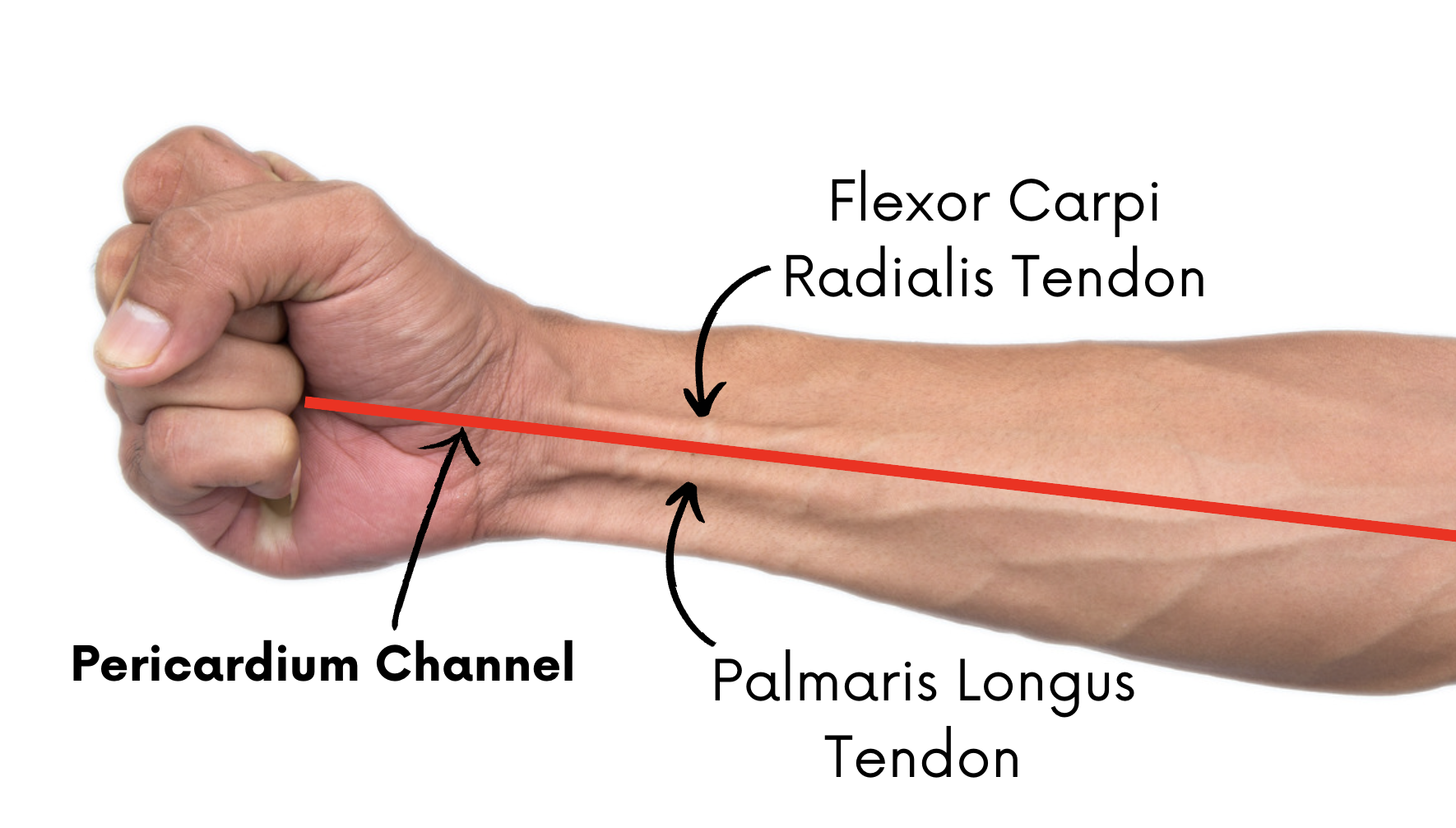
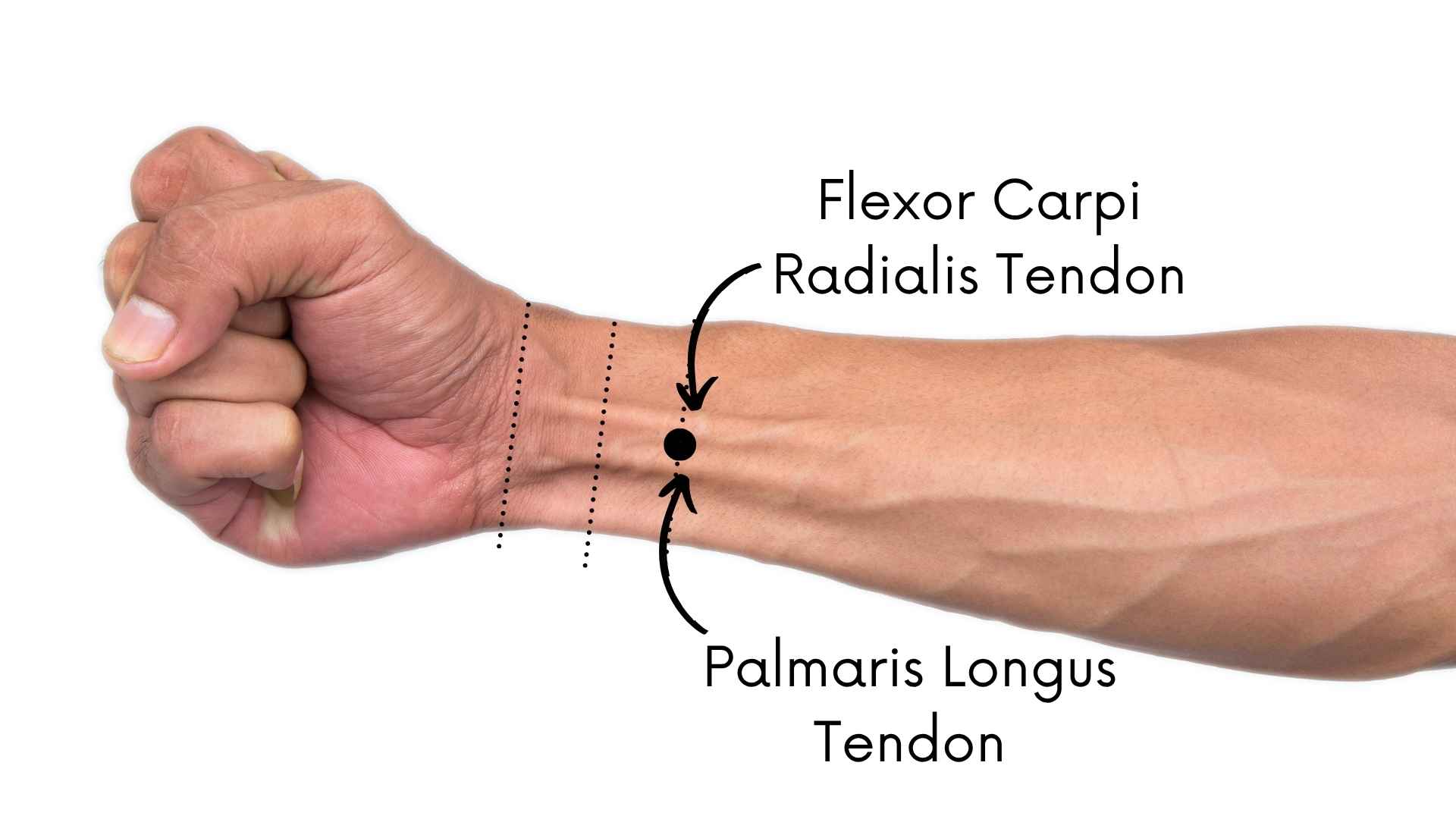
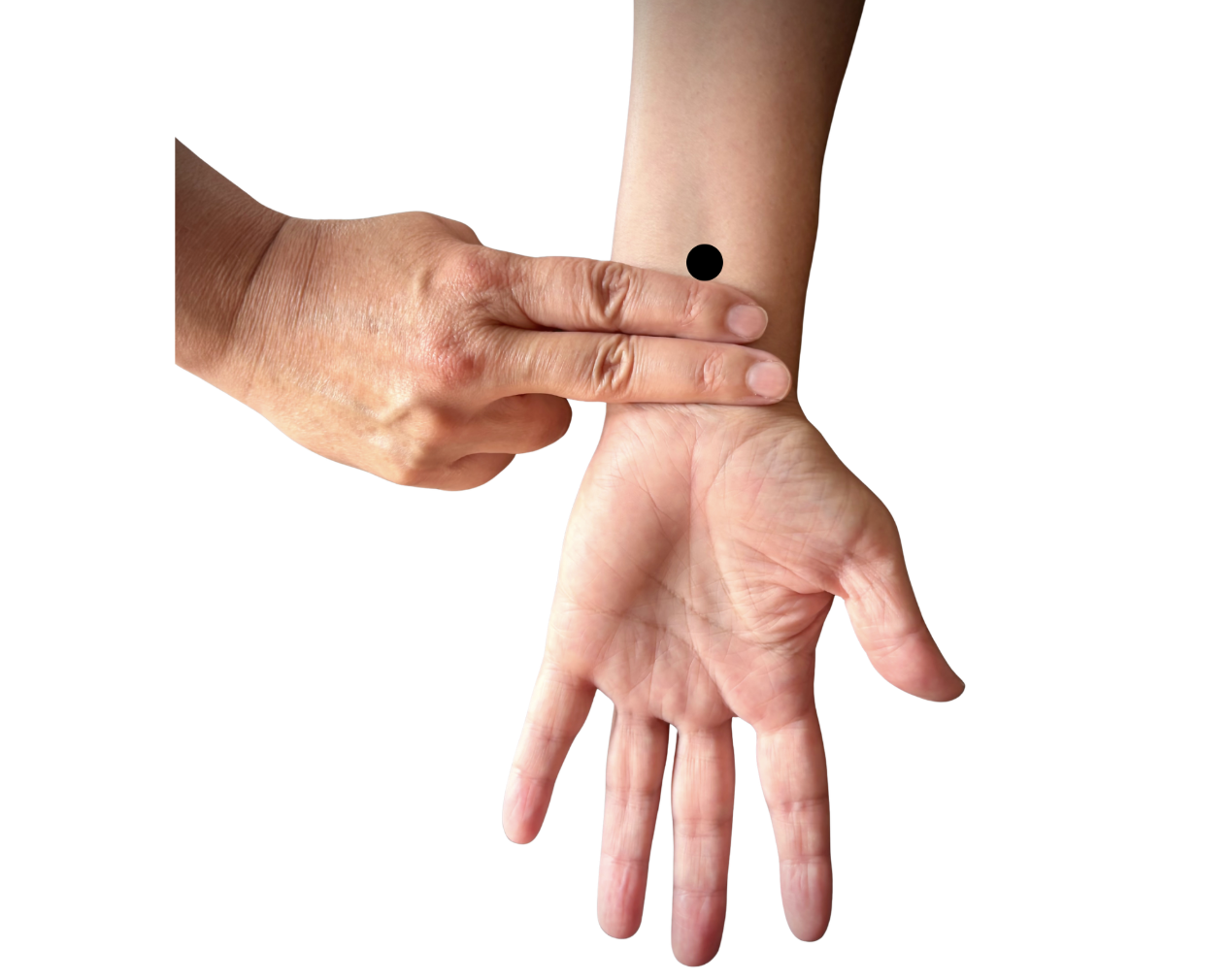
Images are from Anatomical Palpation Mastery for Acupuncturists online course.
,
The Western Science of PC6
This is where PC6 becomes genuinely remarkable — because unlike most acupuncture points, its Western clinical application isn’t obscure or theoretical. It’s sitting in pharmacies right now.
The acupressure wristband: Sea-Bands and similar motion-sickness wristbands work by applying constant pressure directly over PC6. In my opinion, these older wristbands don’t work extremely well as I find the pressure isn’t strong enough to encourage the stimulation we need to initiate the anti-emetic effects. However, more modern wrist bands with an electrical pulse directed on PC6 seem to be much more effective – like this one. Much like with an acupuncture treatment, the amount of sensation matters.
Antiemetic mechanism: Multiple systematic reviews and meta-analyses have found PC6 stimulation reduces postoperative nausea and vomiting (PONV) and chemotherapy-induced nausea, with effect sizes that hold up even against pharmaceutical antiemetics in some comparisons. Here is my short version of how stimulating this area helps with nausea: needling this area stimulates local nerve fibres (A beta, A delta, some C fibres), this sends a signal to the dorsal vagal complex which is the information hub for nausea in the body. Essentially, stimulating PC6 modulates the nerve that can influence nausea and vomiting.
Cardiac and autonomic effects: PC6 stimulation has been shown to influence heart rate variability, an established marker of autonomic nervous system balance. This gives a plausible physiological basis for its classical use in palpitations and its clinical effect on anxiety — it appears to shift the nervous system toward a parasympathetic, “rest and digest” state.
Anxiolytic research: Several trials have found PC6 (often combined with HT7 or auricular points) reduces preoperative anxiety and state anxiety scores comparable to some pharmacological interventions, without the sedation or side-effect profile.
The TCM Perspective
PC6 is the Luo-Connecting point of the Pericardium channel, linking it to its paired Triple Burner channel (San Jiao) — but its real significance comes from its role as the Master point of the Yin Wei Mai, the Yin Linking Vessel, one of the eight extraordinary vessels.
The Yin Wei Mai’s job is to link and stabilize the yin channels of the body and regulate the interior — particularly the chest, heart, and stomach. This is precisely why PC6 has such reach across seemingly unrelated presentations: chest tightness, cardiac-type anxiety, and epigastric/stomach complaints are all, from a TCM lens, disturbances along this same interior pathway.
Pericardium: protects the Heart, houses part of the Shen (mind), governs Blood circulation and emotional regulation
Triple Burner (paired channel): regulates fluid movement and the free flow of Qi through the three body cavities
Classical Actions:
- Regulates the Qi of the chest and diaphragm
- Calms the Shen and settles the Heart
- Harmonizes the Stomach and descends rebellious Qi
- Opens the chest and relieves oppression
- Regulates the Yin Wei Mai
- Moves Qi and Blood stagnation in the chest
Classical Indications:
- Nausea, vomiting, hiccup, epigastric pain
- Palpitations, chest pain and oppression, angina-type presentations
- Anxiety, insomnia, restlessness, mania in severe cases
- Morning sickness and motion sickness
- Emotional constraint, Liver Qi stagnation affecting the chest
- Malar flushing and Heart Fire patterns
Clinical Pearls from 25 Years in Practice
1. PC6 for Anxious or Needle-Nervous Patients
Some people find this area a little sensitive – I will use my clinical judgement to opt for an embedded needle (tack) rather than a normal needle. For one, it is more comfortable for them and two, there is no chance they will hit the needle if they decide to move their arm or scratch their nose. A regular 1 cun needle is preferred but I like to consider this depending on the type of client that comes in.
2. Teach the Acupressure Version — It’s a Genuine Home-Care Tool
Because the wristband already exists as a mainstream product, patients accept PC6 acupressure instruction without any issue. Show them the point directly (not just “wear the band”) — self-applied pressure during acute nausea or anxiety gives patients real agency between sessions.
3. Don’t Reserve PC6 for “Emotional” Cases Only
New practitioners often default to PC6 only for anxiety-coded presentations. Its Stomach-harmonizing, rebellious-Qi-descending action makes it just as valuable for straightforward digestive complaints — nausea, reflux, hiccups — even with no emotional component at all.
4. Bilateral Needling for Acute Nausea
For acute nausea (post-op, chemotherapy-related, or morning sickness), needle bilaterally rather than unilaterally. The research supporting PC6’s antiemetic effect is almost entirely built on bilateral stimulation protocols.
5. PC6 + HT7 Is Your Go-To Calming Combination
When a patient presents with anxiety affecting sleep, or a racing, unsettled quality to their presentation, PC6 combined with HT7 is one of the most reliable calming combinations in the entire point system — I reach for this pairing constantly. I will always add auricular acupuncture to this and often a point on the head like Yin Tang.
Interesting and Unexpected Applications
Chemotherapy-induced nausea: PC6 is one of the most researched acupuncture points in oncology supportive care. Many cancer centers now incorporate PC6 acupressure bands or acupuncture as an adjunct to standard antiemetic medication protocols — this is genuinely mainstream integrative oncology practice, not fringe.
Preoperative and dental anxiety: Some anesthesiology and dental practices use PC6 stimulation (needle, acupressure, or even electrical stimulation devices) as part of preoperative anxiety protocols, reducing reliance on benzodiazepines in select patients.
Cardiac rehabilitation support: Given its influence on heart rate variability and its classical connection to the Heart and chest, PC6 shows up increasingly in integrative cardiac rehab settings as an adjunct for anxiety and stress management in cardiac patients — always alongside, never replacing, standard cardiac care.
Hyperemesis gravidarum: PC6 (via acupressure or needle) is one of the more evidence-supported non-pharmacological interventions for severe pregnancy-related nausea, and is worth discussing with obstetric providers as a complementary option.
PC6 Is Just 1 of the Top 10 Points Every Practitioner Needs to Know
I've put together a free guide covering all 10 essential acupuncture points — including clinical actions, key combinations, and location tips for each one. PC6 is in there, along with 9 others you'll use in clinic every single day.
Yes, Send Me the Free Guide →100% free — no spam, unsubscribe anytime
| Combination | Clinical Indication |
| PC6 + HT7 | Anxiety, insomnia, palpitations, restlessness |
| PC6 + ST36 | Nausea, vomiting, motion sickness, general digestive upset |
| PC6 + SP4 | Coupled point pair (Chong Mai master + Yin Wei Mai master) — epigastric and chest complaints together |
| PC6 + LV3 | Emotional constraint, chest oppression from Liver Qi stagnation |
| PC6 + GV20 | Anxiety with a scattered, unsettled mental quality |
| PC6 + CV17 | Chest tightness, oppression, difficulty taking a full breath |
| PC6 + SP6 | Insomnia with emotional component, anxiety affecting sleep |
| PC6 + Yintang | Anxiety, racing thoughts, difficulty settling the mind |
PC6 and SP4 form one of the classical “coupled point” pairs of the eight extraordinary vessels — Yin Wei Mai and Chong Mai together govern much of the chest and abdominal interior, which is why this combination shows up so often when both digestive and emotional/chest symptoms are present simultaneously. I also use this combo a lot with many menstrual complaints.
Contraindications and Cautions
- Median nerve sensation: Mild tingling or a brief electric sensation into the hand is common and expected given the median nerve’s proximity — reassure patients this is normal, but adjust angle slightly if the sensation is sharp or persistent rather than a brief transient jolt.
- Absent palmaris longus: Roughly 10–15% of people lack this tendon on one or both sides. Don’t rely on it alone as your landmark — confirm with flexor carpi radialis and cun measurement.
- Pregnancy: PC6 itself is not classically contraindicated in pregnancy and is in fact one of the more commonly used points for pregnancy-related nausea — but always needle conservatively and within your scope and comfort level with any pregnant patient.
Ready to Master Point Selection With Confidence?
PC6 is just one point in a much bigger system. My Point Selection Mastery course covers the clinical reasoning behind choosing the right points for any presentation — combinations, extraordinary vessels, and a framework you can apply to every patient who walks through your door.
Yes, I Want to Master Point Selection →$87 · Lifetime access · 30-day money-back guarantee