
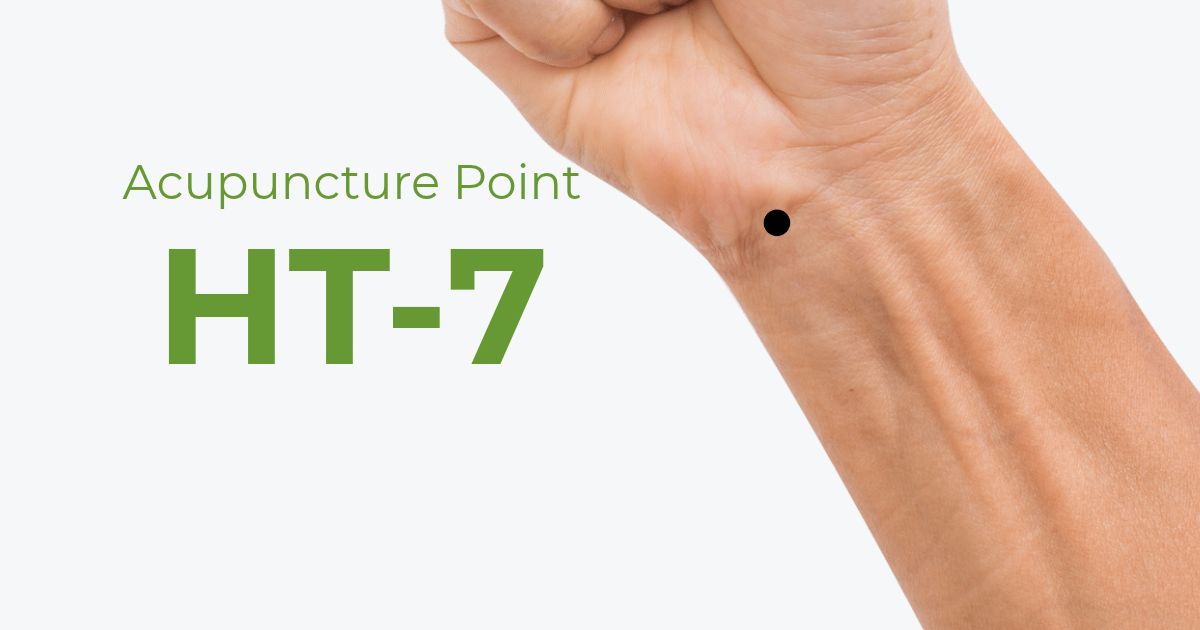
Shenmen. Spirit Gate. If that name sounds familiar, it should. It’s also the name of one of the most popular points in auricular acupuncture, and the two share more than a name.
In TCM, the Shen is usually translated as the Mind. It’s housed by the Heart, and when it’s unsettled, you see it everywhere in clinic: anxiety, racing thoughts, poor sleep, palpitations, a patient who just can’t switch off. HT7 is the gate to that Shen, which is why its actions can be summed up in three words: it calms the Mind.
| POINT NAME | Shenmen — "Spirit Gate" |
| CHANNEL | Heart (Hand Shaoyin) |
| POINT NUMBER | HT7 |
| POINT TYPE | Source (Yuan) point, Stream (Shu) point |
| ELEMENT | Fire |
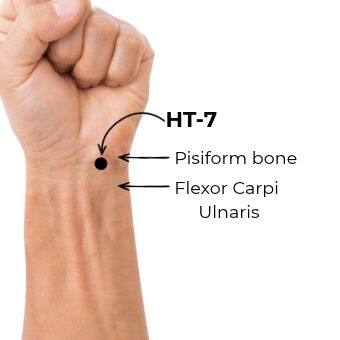
| LOCATION | At the most distal, dominant wrist crease, on the radial side of the flexor carpi ulnaris tendon, just radial and slightly proximal to the pisiform bone |
What HT7 Does
HT7 is the Source (Yuan) point of the Heart channel, which makes it one of the most reliable points for strengthening the Heart itself. Its main actions are:
- Calms the Mind (Shen): anxiety, irritability, restlessness, mental agitation and emotional overwhelm
- Nourishes Heart Blood: poor memory, dream-disturbed sleep, being easily startled, palpitations
- Supports sleep: difficulty falling asleep, waking through the night, sleep that isn’t restful
Because the Heart houses the Shen, almost any pattern that disturbs the Heart shows up as a disturbance of the Mind, and HT7 is one of the first points I reach for when it does. It’s especially useful when the presentation has a deficient quality: the anxious, tired patient who wakes at 3 a.m. with their thoughts already running.
HT7 is also the Earth point on a Fire channel. In Five Element terms, Earth is the “child” of Fire, so HT7 is traditionally considered the sedation point of the Heart channel. In practice, though, most practitioners use it far more for nourishing and calming than for draining.
Body Shenmen vs. Ear Shen Men
Students often ask whether HT7 and the ear point Shen Men are related. They’re different points, in different locations, but they share a name and a purpose: both are used to calm the Mind.
Ear Shen Men sits in the triangular fossa of the ear and is one of the five points of the NADA protocol. HT7 sits at the wrist on the Heart channel. In clinic, they make a natural pairing: HT7 working through the channel system, and ear Shen Men working through the ear’s own reflex system. For a stressed or anxious patient, using both is a simple and effective combination.
How to Locate HT7 Accurately
HT7 is located at the wrist crease, on the radial side of the flexor carpi ulnaris tendon, just proximal to the pisiform bone. That sounds straightforward, but there are two details that trip students up.
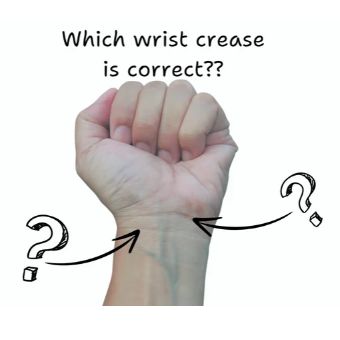
1. Choose the right wrist crease
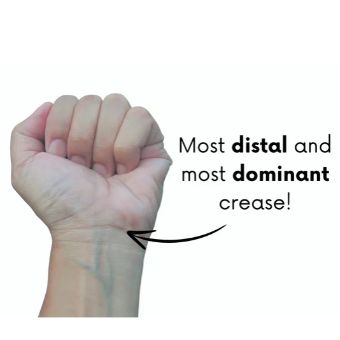
Many people have several creases at the wrist. Choose the crease that is the most dominant and the most distal.
A helpful check: look at the change in skin texture, from forearm skin to palm skin. Where the skin changes is usually where the wrist crease points are located.
2. Stay on the thumb side of the tendon
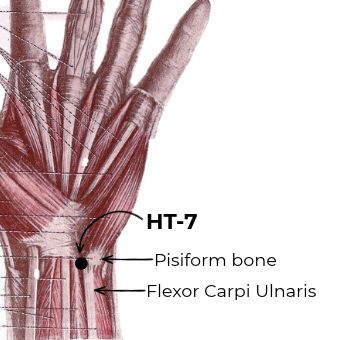
The pisiform bone and the flexor carpi ulnaris tendon are your two key landmarks. The tendon attaches to the pisiform, so start by finding the pisiform, the small, rounded bone at the base of the hypothenar eminence. Then palpate just proximal to it for the dense cord of the tendon.
HT7 sits on the radial side of that tendon, the thumb side, at the distal dominant wrist crease.
The most common mistake: needling on the ulnar side of the tendon. Avoid it by finding the tendon first, every time, and staying on its radial side.
This rule applies to all four Heart points in this area, HT4, HT5, HT6 and HT7. They all sit on the radial side of the flexor carpi ulnaris tendon, so once you can feel the tendon, you can find all four.

Needling HT7: Positioning Makes All the Difference
HT7 is a little sensitive simply because of where it is, so how you position your patient matters as much as your technique.
Prone (face down): the easiest option
HT7 is very easy to access when your patient is lying face down with their arms at their sides. In this position, the wrist naturally rests in slight flexion, which reduces skin tension over the point and makes needling more comfortable.
Supine (face up): think about the hands
HT7 can be needled face up, but hand position needs some thought. You don’t want your patient holding their forearms in supination for the whole treatment. Make sure their hands and arms are completely relaxed and supported before you insert the needle.
This matters for another reason too. Because HT7 is a sensitive point, you don’t want your patient spending the whole treatment worrying that they’ll knock the needle if they move their hand. A relaxed, supported position lets them actually relax, which is the whole point of HT7.
For very sensitive patients: press needles
For patients who are especially sensitive, I sometimes use a press needle. Once inserted, it sits flat against the skin with no handle, so patients can’t hurt themselves if they move or bump it.
The trade-off: press needles are very fine, and some patients barely notice any De Qi sensation with them. You still want your patient to feel something, so I keep press needles for the patients who genuinely need them.
Depth and safety
Needle HT7 perpendicularly, to a depth of about 0.3–0.5 cun. The ulnar artery and nerve run close to this area, so keep your insertion shallow and your manipulation gentle.
| COMBINATION | CLINICAL INDICATION | TYPE |
|---|---|---|
| HT7 + PC6 | Palpitations, insomnia and anxiety; calms the Mind | Classical |
| HT7 + ST36 | Nourishes Heart Qi and Blood; calms the Mind | Classical |
| HT7 + SP6 | Heart and Spleen Blood deficiency; insomnia, anxiety and poor memory | Classical |
| HT7 + KD3 | Heart and Kidneys not communicating; Yin deficiency insomnia | Classical |
| HT7 + CV4 | Nourishes Heart Blood | Classical |
| HT7 + CV17 | Chest symptoms; palpitations and chest oppression | Classical |
| HT7 + Yintang | Calms the Mind; anxiety | Classical |
| HT7 + CV14 | Regulates the Heart; palpitations | Classical |
| HT7 + UB15 | Tonifies and regulates the Heart; calms the Mind | Classical |
| HT7 + Ear Shen Men | Body and ear "Spirit Gates" together for stress and anxiety | Classical |
HT7 as an Acupressure Point
HT7 is also an excellent self-care point. Gentle, steady pressure with the thumb for 1–2 minutes, on one or both wrists, can help patients wind down before bed or settle during a stressful moment. It’s an easy point to teach patients to use between treatments.
Key Takeaways
- Shenmen means Spirit Gate. HT7’s core action is calming the Mind (Shen).
- It’s the Source point of the Heart, making it one of the most reliable points for anxiety, insomnia and palpitations.
- Locate it at the most distal, dominant wrist crease, on the radial (thumb) side of the flexor carpi ulnaris tendon, just proximal to the pisiform.
- Never on the ulnar side of the tendon. The same rule applies to HT4, HT5 and HT6.
- Position matters. Prone is easiest; face up, make sure the hands are fully relaxed.
Frequently Asked Questions
HT7 is the Source point of the Heart channel. Its main action is calming the Mind (Shen), which makes it one of the most commonly used points for anxiety, insomnia, palpitations, poor memory and emotional overwhelm. It also nourishes Heart Blood.
Shenmen means "Spirit Gate." The Shen is usually translated as the Mind in TCM, and it's housed by the Heart. HT7 is the gate to the Shen, which is why its actions are so closely tied to calming the Mind.
No. They share a name and a purpose, calming the Mind, but they're different points. Ear Shen Men is in the triangular fossa of the ear and is part of the NADA protocol, while HT7 is on the Heart channel at the wrist. They work well together for stress and anxiety.
At the most distal, dominant wrist crease, on the radial (thumb) side of the flexor carpi ulnaris tendon, just proximal to the pisiform bone. The most common mistake is being on the ulnar side of the tendon, so always find the tendon first and stay on its thumb side.
Its location at the wrist crease makes it naturally sensitive. Needling with the patient face down, where the wrist rests in slight flexion, reduces skin tension and makes it more comfortable. If needling face up, make sure the hands and arms are fully relaxed and supported.
Yes. HT7 is an excellent self-care point. Gentle, steady pressure with the thumb for 1–2 minutes, on one or both wrists, can help patients wind down before bed or settle during a stressful moment.