



If there’s one point that makes students nervous and clinicians quietly confident, it’s GB21.
It sits right there on the shoulder — easy to find, easy to needle, incredibly useful in clinic. And yet it’s also the most pneumothoraxed point in acupuncture. So yes, it deserves your full attention.
Let’s break it down properly.
What Is GB21 (Jianjing)?
GB21 — known in Chinese as Jianjing (肩井), meaning “shoulder well” — is point 21 on the Gallbladder channel. It sits on the trapezius muscle at the top of the shoulder and is one of the most recognizable points in the body. Patients often point straight to it when they say their shoulders are tense. They’re not wrong.
It’s a local point, a channel point, and a point with some genuinely interesting actions — all of which we’ll get to below.
Location: How to Find GB21
A lot of texts make this more complicated than it needs to be by emphasising C7 as the medial landmark – this takes up too much time – especially during a practical exam! You don’t need C7. Here’s a simpler and equally accurate approach:
Two landmarks. One midpoint.
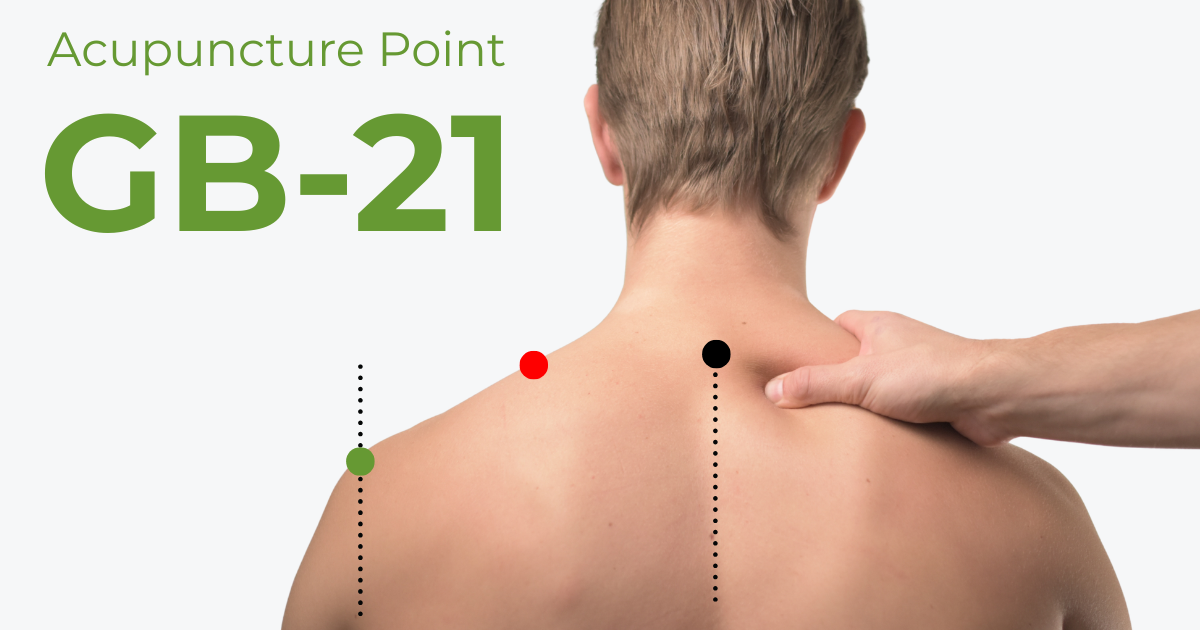
- Find the lateral tip of the acromion (the green dot in the image above) — that’s the most lateral bony point of the scapula.
- Find the midline (the black dot) — the spinous processes running down the centre of the back.
- Split the distance between them in half.
- Now find the highest point of the shoulder at that midpoint — get down to eye level to do this accurately. Not too far anterior, not too far posterior. Right at the peak.
That’s GB21 (the red dot).
It sounds almost too simple, but this approach is reliable and it’s how I teach it. The C7 emphasis in many texts really isn’t necessary if you think about it. Work from the acromion tip and the midline, meet in the middle, go to the height — you’ll be on GB21 every time.
Needling GB21: The Most Important Conversation in This Article
Let’s address the elephant in the room — or more accurately, the lung beneath the needle.
GB21 is the most commonly pneumothoraxed point in acupuncture.
Here’s the thing though: it’s almost never acupuncturists causing this. The majority of pneumothorax incidents at GB21 are associated with dry needling practitioners who haven’t received the same depth of anatomical training. That’s not a dig — it’s just the reality of what the literature and incident reports show.
If you know your anatomy and you needle with care, this is a completely preventable complication.
The key rules for safe needling at GB21:
1. Oblique is your friend. You’ll see videos online of practitioners needling GB21 in all directions — perpendicular, anterior, posterior, lateral. The safest approach is oblique. Needle obliquely — laterally, anteriorly, or posteriorly — rather than straight down. An oblique angle significantly reduces the risk of going too deep toward the apex of the lung.
2. If you needle perpendicularly, do not go deep. A perpendicular insertion is possible, but depth must be much more conservative. The trapezius is not as thick as it looks, particularly in lean patients.
3. Grasp the trapezius. This is a technique worth building into your routine — pinch and lift the trapezius muscle before inserting the needle. This moves the muscle away from the underlying structures, gives you a cleaner target, and gives you a tactile sense of tissue depth. It’s both safer and the distraction of your hand touching the tissue around the needle site tend to be more comfortable for the patient.
4. Know your anatomy. Thin patients require extra caution. What reads as adequate depth in a broad-shouldered person can be excessive in someone slight. This is exactly the kind of three-dimensional anatomical thinking that separates confident clinicians from anxious ones.
Watch my YouTube video on GB21 and pneumothorax — I cover exactly why this complication happens, how to avoid it, and what the anatomy looks like in detail: GB21 and Pneumothorax — Watch Here
Want to Needle GB21 With Complete Confidence?
Understanding surface anatomy is the difference between hoping you’re in the right place and knowing you are. My Anatomical Palpation Mastery course covers the landmarks, layers, and clinical reasoning that make needling safer and more effective.
Explore Anatomical Palpation Mastery →
Actions and Indications
GB21 punches well above its weight for a local point. Here’s what it does:
1. Local point for neck, shoulder, and upper back pain
This is its bread and butter. Trapezius tension, neck stiffness, shoulder pain, upper back ache — GB21 is often your first thought and frequently your best choice. More on clinical application below.
2. Promotes milk letdown
GB21 has a descending action — it pushes things downward through the channel and the body. This is why it’s traditionally used to promote the milk letdown reflex and assist with breastfeeding difficulties.
3. Promotes labour and descends the foetus
For the same reason — that descending action — GB21 is used in obstetrics to promote labour and help descend the presenting part.
Which brings us to the most important contraindication in acupuncture:
GB21 is contraindicated in pregnancy.
Its descending action makes it capable of promoting labour prematurely. Do not needle GB21 on a pregnant patient…unless you are trying to promote labour.
4. Descends rebellious Qi
Beyond its obstetric and lactation uses, GB21’s descending nature makes it useful any time you want to bring Qi downward — even rebellious Qi and coughing.
Acupressure at GB21
GB21 is one of the most accessible acupressure points on the body — largely because most people have already found it without knowing it. It’s that spot you instinctively reach for when someone offers to rub your shoulders.
For self-acupressure, firm downward pressure with the opposite hand’s thumb or middle finger works well. Hold for 30–60 seconds with steady pressure rather than digging in abruptly.
For practitioners, GB21 acupressure is useful in situations where needling isn’t appropriate — including, of course, pregnancy, where a gentle acupressure approach at nearby non-contraindicated points may still be therapeutic while GB21 itself remains off limits.
Clinical Tips From 25 Years in Practice
A few things that don’t always make it into the textbooks:
Position your patient face down where possible. GB21 is easiest to locate and needle accurately with the patient prone. Face-up is technically possible depending on body type, but in practice pillows tend to get in the way and the shoulder anatomy shifts. I rarely needle it face-up.
Find the most tender spot. When you’re treating pain, don’t be dogmatic about the exact textbook location. Palpate the area and let the patient tell you where it’s most reactive. GB21’s location has some natural variation, and the tender point is usually the right point.
Sort out the hair first. This sounds trivial until you’ve had a needle fall out because a patient’s hair settled across it. Always check that hair is well clear of GB21 before you needle. Keep a supply of spare hair ties in your clinic — you’ll use them more than you’d expect, and patients genuinely appreciate the thought.
The Bottom Line on GB21
GB21 is one of those points that rewards the practitioners who take it seriously. The location is straightforward once you simplify the landmarks. The needling is safe when you respect the anatomy and go oblique. And the clinical applications — from trapezius tension to labour promotion — make it one of the genuinely versatile points in your toolkit.
Just remember: oblique over perpendicular, grasp the trapezius, and never needle it in pregnancy unless promoting labour is the goal.
Drew Nesbitt R.TCMP, R.Ac. has been practising acupuncture for 25+ years and teaching for 18. He runs Acupuncture Masterclass, an online education platform for acupuncture students and practitioners.