
Long before anyone was running randomized controlled trials, TCM physicians were already treating one small spot on the lower abdomen as the body’s power source.
It sits roughly at the anatomical center of gravity — the point where, if you could balance the body on a single pin, the pin would go. Classical texts call this region the Lower Dan Tian, the reservoir where Original Qi (Yuan Qi) is stored, and REN4 sits right in the middle of it.

REN4 and CV4 are the same point — Conception Vessel 4 in the Western/international numbering system, Ren 4 in the traditional Chinese naming. Both refer to Guanyuan, “Gate of Origin,” and the point shows up under either label depending on which textbook or research database you’re reading.
Recalling Actions with “The Big 4”
When I teach students about this point, I often mention that CV4 tonifies the “big four” — Qi, Blood, Yin, and Yang. That’s a broad job description for a single point, but it’s why CV4 shows up in many point prescriptions for such a wide range of deficiency patterns.
Most of that tonifying power is aimed at the Kidney — the organ TCM considers the root of Original Qi, Essence, reproductive function, and the body’s most fundamental resources. That’s the theoretical basis for CV4’s heavy use in fertility work, reproductive health, and urination disorders.
As the Front-Mu (Alarm) point of the Small Intestine and a meeting point of the Ren Mai with the three Leg Yin channels — Liver, Spleen, and Kidney — CV4 also reaches the Spleen, which is why it’s just as useful for tonifying Qi and Blood generally, and for bloating and other lower abdominal complaints that trace back to Spleen deficiency. More on my take as the Front Mu for the Small Intestine below (hint, it’s the last thing I think of when it comes to this point).
Anatomy: How to Actually Find This Point
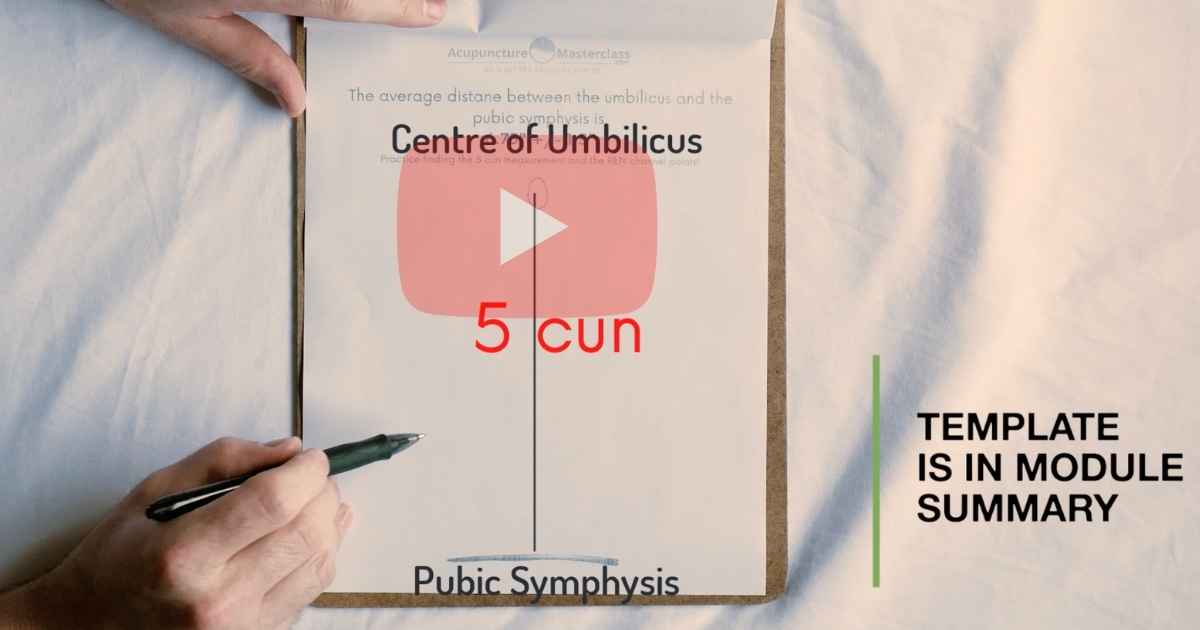
The 5-cun distance between the umbilicus and the pubic symphysis is one of the more awkward proportional measurements to get comfortable with. Women typically have much longer torsos than males, and palpating for important anatomical landmarks can get awkward in this area.
In the video below, I walk through my “2-cun-above / 3-cun-below” method for locating all the CV points in the lower abdomen — it’s worth watching if these lower abdominal proportional measurements haven’t clicked for you yet. I see a lot of my students start with separating the cun distances with their fingers but I find accuracy is difficult with this method. Eventually, you need to train your eyes to see cun distances so this is a great anatomical area to put this to the test.
Nearby Structures
- Bladder — sits just deep to CV4 and rises directly beneath this point as it fills. Always have the patient empty their bladder before needling here, both for comfort and to keep needle depth well clear of it.
- Peritoneal cavity — lies deep to the abdominal wall at this location. Stay conservative with needle depth, particularly in patients with a thinner abdominal wall.
- Rectus abdominis and linea alba — CV4 is needled through the linea alba, the connective tissue seam between the two rectus abdominis muscles on the midline.
A few practical points worth building into your routine here:
- This is a lower-abdomen point, and finding it accurately usually means the patient’s pants need to sit lower than most people are used to for acupuncture. Say so before you start palpating, not after — patients are far more comfortable when they know in advance why you’re asking, rather than being surprised mid-treatment.
- To establish your landmark, ask for consent first, then gently chop down with the side of your hand until you feel the firm superior edge of the pubic symphysis. That’s your starting point for the 5-cun measurement up to the mid-point of the umbilicus.
- Practice this on my template — I have a free one at https://acupuncturemasterclass.com/free-template/ — is a good way to build confidence with these proportional measurements before doing it on a live patient for the first time.
What the Science is Finding
CV4 shows up consistently in the international reproductive medicine literature, usually as one of a small number of “hub” points selected through formal analysis rather than tradition alone. A 2021 randomized controlled trial in the Journal of Clinical Medicine used network analysis to select acupoints for women with poor ovarian response undergoing IVF, and CV4 was among eight points identified through degree and betweenness centrality analysis, with the acupuncture-plus-IVF group showing a significant increase in retrieved mature oocytes compared to IVF alone, particularly in women over 37.
A 2022 systematic review and meta-analysis in Evidence-Based Complementary and Alternative Medicine pooled 27 randomized controlled trials covering 7,676 cases evaluating acupuncture for female infertility, with CV4 (listed as RN4/CV4) among the most frequently used points across the included protocols.
More recently, a 2026 study protocol in Frontiers in Endocrinology for ovulation induction in PMOS (Polyendocrine Metabolic Ovarian Syndrome) uses CV4 as part of a fixed acupoint set for the supine treatment position in a multicenter, randomized, sham-controlled trial — worth noting given this journal’s use of the updated PMOS terminology.
A separate 2025 study in Immunity, Inflammation and Disease found that electroacupuncture at CV4 improved pain in pelvic inflammatory disease by inhibiting neuroinflammation and sympathetic activity, offering one possible physiological mechanism behind a point that TCM has used for pelvic and reproductive complaints for centuries.
Clinical Pearls from Practice
- Communicate before you palpate. This is a lower-abdomen point, and finding it accurately usually means the patient’s pants need to sit lower than most people are used to for acupuncture. Say so before you start palpating, not after — patients are far more comfortable when they know in advance why you’re asking, rather than being surprised mid-treatment.
- Ask consent before landmarking. To establish the pubic symphysis as your landmark, ask for consent first, then gently chop down with the side of your hand until you feel the firm superior edge of the bone. That’s your starting point for the 5-cun measurement up to the mid-point of the umbilicus.
- Have the patient empty their bladder first. The bladder sits just deep to CV4 and rises directly beneath it as it fills — always ask the patient to empty their bladder before needling here.
- Watch sensitivity around menstruation. Many patients are more sensitive to needling at CV4 in the days just before and during their period. If a patient already deals with significant period pain, this may not be the point to lean on that week — SP6 and LI4 are very accessible and are more effective for dysmenorrhea in that window.
- Be selective with pregnancy. CV4 can be needled during the early weeks of pregnancy (never in later pregnancy), but many patients who’ve struggled with infertility feel anxious about being needled here once a pregnancy is confirmed. If you aren’t an experienced acupuncturist with extra training in obstetrics, it’s often best to avoid this point altogether — and even if it isn’t contraindicated for a particular patient, if they seem anxious about it, don’t needle it just because you technically can.

CV4 is Just 1 of the Top 10 Points Every Practitioner Needs to Know
A free guide to all 10 essential points: clinical actions, key combinations and location tips for each, plus a bonus Back-Shu points chart.
Send Me the Free Guide →100% free — no spam, unsubscribe anytime
Frequently Asked Questions
What does CV4 treat in TCM?
What is the Lower Dan Tian?
How do I find CV4 accurately?
Is CV4 safe to needle during menstruation?
Is CV4 safe to needle during pregnancy?
What points combine well with CV4?
References
Kim, J., Lee, H., Choi, T.-Y., Kim, J. I., Kang, B.-K., Lee, M. S., Joo, J. K., & Lee, K. S. (2021). Acupuncture for poor ovarian response: A randomized controlled trial. Journal of Clinical Medicine, 10(10), 2182. https://doi.org/10.3390/jcm10102182
Quan, K., & Yu, C. (2022). Acupuncture as treatment for female infertility: A systematic review and meta-analysis of randomized controlled trials. Evidence-Based Complementary and Alternative Medicine, 2022, 3595033. https://doi.org/10.1155/2022/3595033
Li, J., Li, Z., Pei, L., Sun, J., Wang, J., Lu, Q., Yang, L., Hang, T., Qi, L., Zhang, Q., An, D., Su, C., Lu, G., Yan, X., Fang, Y., & Xu, H. (2026). Acupuncture for ovulation induction in polycystic ovary syndrome: Study protocol for a multicenter, randomized, sham-controlled trial. Frontiers in Endocrinology, 17, 1893429. https://doi.org/10.3389/fendo.2026.1893429
Qu, J., Peng, Y., Shen, X., Xiong, J., Wang, H., Xiao, X., & Wang, Y. (2025). Electroacupuncture of Guanyuan (CV4) acupoint improved pelvic inflammatory disease pain by inhibiting neuroinflammation and sympathetic activity. Immunity, Inflammation and Disease. https://doi.org/10.1002/iid3.70299