
If most points work in one direction, DU20 is unusual for working in two — and that duality is exactly what makes it one of the most versatile points you’ll ever use.
Baihui. “Hundred Meetings.” The name reflects its location: the crown of the head, where the Governing Vessel meets nearly every yang channel in the body. Physically, this convergence gives DU20 its signature raising action — lifting what has sunk, whether that’s a prolapsed organ or a depleted, sunken mood. Mentally and spiritually, the same point calms and settles — bringing a racing, scattered mind back to center.
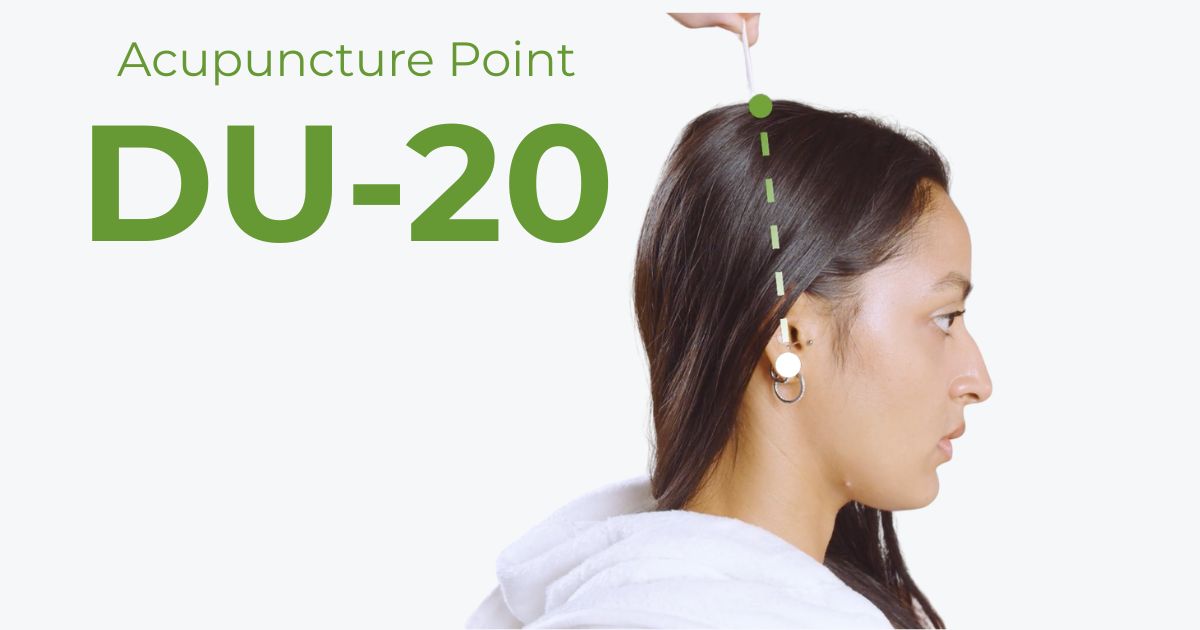
Two directions. One point. Let’s make sure you know exactly where to find it.
Anatomy: How to Actually Find This Point
DU20 sits at the literal highest point of the skull, and unlike points buried in muscle or tendon, this one is almost entirely about surface landmarks — genuinely one of the easier points to locate with confidence.
The classic method: find the apex of both ears, then draw an imaginary line straight up and over the top of the head connecting them. DU20 sits at the midpoint of that line, directly on the midline of the skull.
Cross-check with the midline: run your finger along the sagittal suture (the midline seam of the skull) from the glabella (between the eyebrows) back toward the occiput. DU20 sits roughly at the highest point of the head along this same midline — the two methods should land you in the same spot.
Patient positioning: seated is easiest for most practitioners, with the patient’s head level and relaxed. This is a comfortable point for most patients to have needled, often described as barely noticeable once placed — a useful point to include even in patients who are generally more needle-sensitive elsewhere.
Nearby structures: this is a superficial point over the skull — no major vascular or nerve structures to be cautious of at standard depth, though an unusually shallow, oblique insertion (rather than perpendicular) is standard technique here given the limited soft tissue at this location.
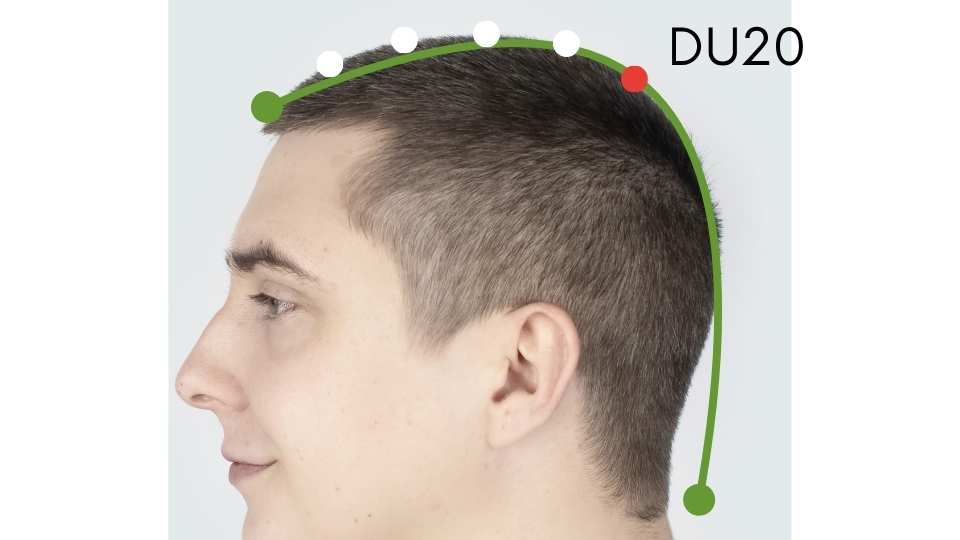
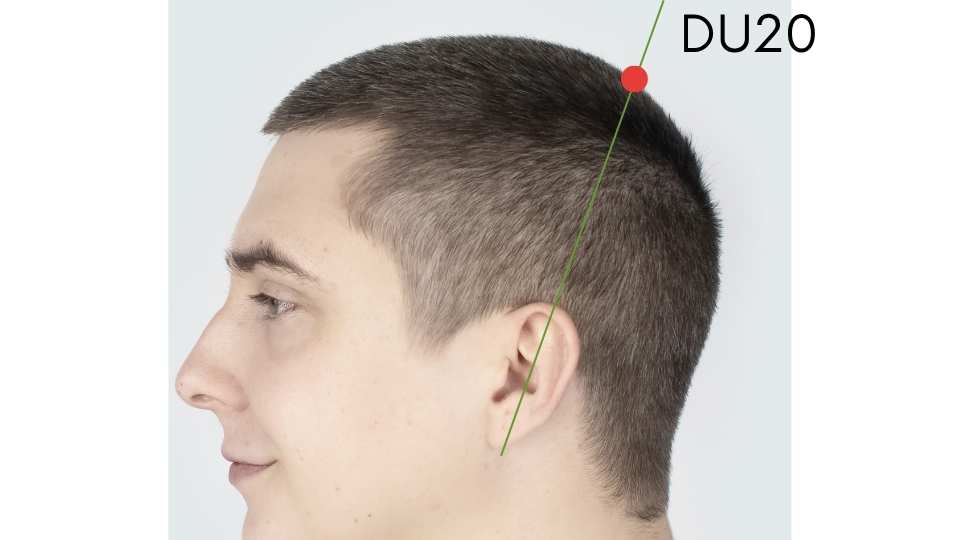
Images are excerpts from the Anatomical Palpation Mastery for Acupuncturists online course.
The Western Science of DU20
DU20’s Western research base is smaller than PC6’s or GB20’s, but what exists points toward a genuinely interesting mechanism behind its dual “raising and calming” reputation.
EEG and cortical activity: Several studies using EEG have found DU20 stimulation shifts brainwave patterns toward increased alpha activity — a state associated with calm, relaxed alertness. This offers a plausible physiological basis for its classical Shen-calming use.
Post-stroke rehabilitation research: DU20 (often combined with other Governing Vessel and scalp points) appears in a meaningful body of stroke-rehabilitation research, particularly scalp acupuncture protocols, with some studies showing improved motor recovery outcomes when acupuncture is used alongside standard rehabilitation — never as a replacement for it.
Cerebral blood flow: Doppler studies have found DU20 stimulation associated with changes in cerebral blood flow velocity, which may partly explain both its classical use for dizziness and its application in cognitive and post-stroke contexts.
Antidepressant research: A number of clinical trials have examined DU20 (frequently as part of a broader scalp or body point protocol) for depression, with several showing meaningful symptom improvement — though as with most acupuncture-for-depression research, study quality varies and this should be positioned as adjunctive, not a replacement for appropriate mental health care.
Want to see the correct oblique needle angle at DU20, along with scalp acupuncture technique for post-stroke protocols? [Watch the video →]
The TCM Perspective
DU20 sits on the Governing Vessel (Du Mai) — the “sea of yang” — at the exact point where it meets the Bladder channel and, by extension, connects with virtually every yang channel in the body. This convergence is the real reason DU20’s clinical reach is so broad.
Its raising action works on two levels simultaneously: physically lifting sunken Qi (as in organ prolapse, chronic diarrhea from Spleen Qi sinking, or hemorrhoids), and — because the Governing Vessel runs directly to the brain — lifting a depleted or “sunken” emotional state as seen in depression with fatigue and low mood. To facilitate this action, needling is typically anteriorly – with the flow of Qi.
Its calming action comes from a different mechanism: as the point where all yang energy converges at the highest point of the body, DU20 has a unique ability to anchor and settle excess yang activity — restless, racing, or scattered mental states, and Interior Wind patterns like dizziness. To facilitate this action, needling is typically posteriorly – against the flow of Qi.
Classical Actions:
- Raises sunken Yang Qi
- Calms the Shen (mind) and anchors the spirit
- Clears the sense organs and benefits the head
- Extinguishes Interior Wind
- Opens the orifices (used classically for loss of consciousness, in combination with other points)
- Tonifies Yang and Qi at the crown
Classical Indications:
- Organ prolapse — uterine, rectal, gastric
- Chronic diarrhea from Spleen Qi sinking
- Depression, low mood, mental fatigue with a “sunken” quality
- Dizziness, vertigo (Interior Wind or Qi/Blood deficiency patterns)
- Headache, especially at the vertex
- Insomnia, restlessness, an unsettled or scattered mind
- Post-stroke recovery, memory and cognitive support
- Hemorrhoids (via the same Qi-sinking mechanism as prolapse)
Clinical Pearls from 25 Years in Practice
1. Match Your Technique to the Direction You Need
For raising/tonifying (prolapse, sunken Qi, depression with fatigue), use a warming or tonifying technique — moxa at DU20 is one of the classic applications here, and genuinely effective. However, the practicality of doing moxa in this area makes this a rare occurrence in my clinic. Not many people are relaxed with something smoking close to their hair but it is worth a mention. For calming (anxiety, restlessness, Interior Wind), a gentler, more even technique without heat is more appropriate. Same point, different intention, different outcome.
2. DU20 for Prolapse Is Underused
Uterine prolapse, hemorrhoids, chronic loose stool are all signs of Qi Sinking — needling DU20 is one of the most classically supported and clinically reliable applications of this point. Don’t skip it.
3. DU20 Is a Reliable “First Point” for Anxious or Overwhelmed Patients
Because it’s comfortable, non-threatening, and produces a fast, noticeable settling sensation for most people, I frequently use DU20 early in treatment for patients presenting with a scattered, overwhelmed, or racing quality — it helps set the tone for the rest of the session. NOTE – some patients will simply have a general anxiety about any points on the head so this may not be the case for everyone.
4. Don’t Overlook It for Postpartum Presentations
Postpartum depression with fatigue, and postpartum prolapse symptoms, are both classic Sinking-Qi presentations where DU20 (often with moxa, and combined with points like ST36 and CV6) deserves a place in the treatment plan far more often than it’s actually used.
5. Combine Direction-Matched Points, Not Just Popular Ones
DU20 works best paired with points that share its intended direction — ST36 or BL20 for a raising/prolapse protocol, HT7 or Yintang for a calming protocol. Mixing directions without a clear rationale dilutes the treatment’s overall intention.
Interesting and Unexpected Applications
Postpartum prolapse and fatigue: As mentioned above, this is a genuinely underused application. The combination of physical sinking (prolapse, hemorrhoids) and emotional sinking (depleted, low mood) postpartum maps almost perfectly onto DU20’s classical raising action.
Scalp acupuncture protocols for stroke recovery: DU20 frequently anchors broader scalp acupuncture systems used in stroke rehabilitation — worth exploring further if post-stroke care is part of your practice.
ADHD and attention difficulties: Some practitioners use DU20 as part of a broader protocol for attention and focus difficulties in both children and adults, drawing on its Shen-anchoring, mind-clearing classical action — an area with growing clinical interest, though the research base here is still developing.
Chronic fatigue with a “foggy,” unable-to-lift-off-the-ground quality: For patients who describe fatigue less as “tired” and more as “heavy, sunken, can’t get going,” DU20’s raising action is often a better clinical fit than more generic Qi-tonifying points alone.
Contraindications and Cautions
- Needle angle: Given the limited soft tissue at the crown, use a shallow, oblique (rather than perpendicular) insertion — subcutaneous, along the direction of the scalp rather than straight down.
- Fontanelle awareness in infants: If treating infants or very young children (outside most acupuncturists’ scope, but worth knowing), the anterior fontanelle may not be fully closed — this point requires particular caution or avoidance in that population.
- Avoid over-stimulation in acute mania or agitation: While DU20 calms in most contexts, its yang nature means aggressive stimulation in an acutely manic or highly agitated presentation should be approached cautiously — gentler technique is generally more appropriate here.
See if DU20 Made the Top 10 Points Every Practitioner Needs to Know
A free guide to all 10 essential points: clinical actions, key combinations and location tips for each, plus a bonus Back-Shu points chart.
Send Me the Free Guide →100% free — no spam, unsubscribe anytime