
Clear heat from everywhere. That’s the one phrase to remember about LI-11. Whether the heat comes from excess or deficiency, and from whichever organ, LI-11 is one of the first points I reach for to clear it.
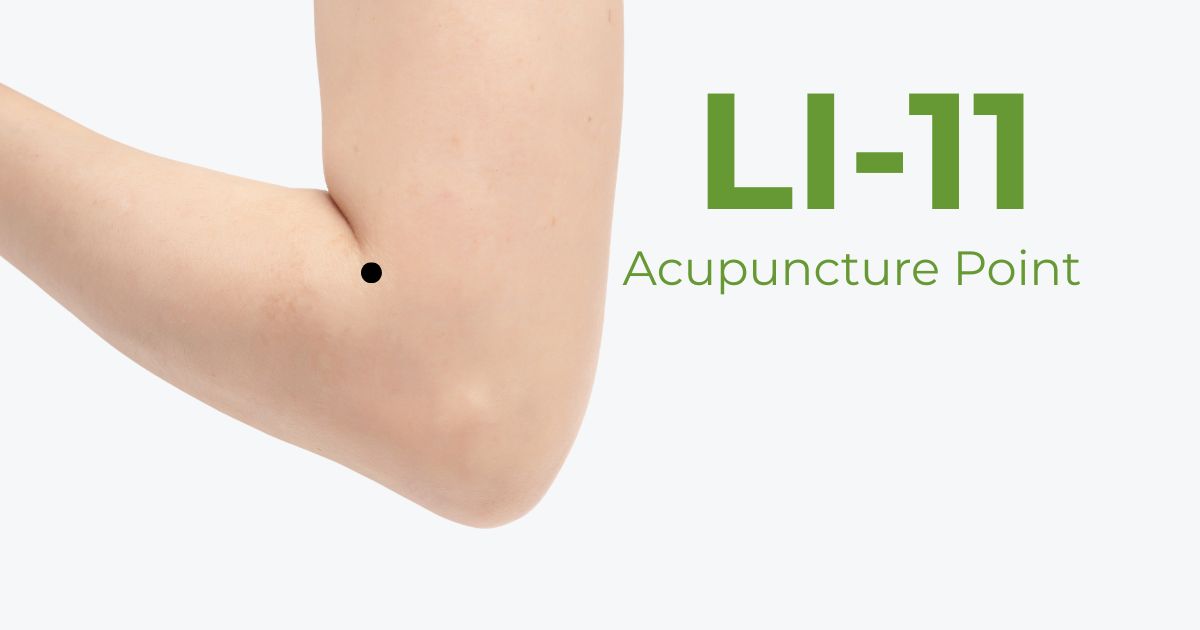
Its Chinese name is Quchi (曲池), “Pool at the Crook.” The name describes exactly where it sits: in the small depression at the crook of the elbow when the arm is bent.
In this article, I’ll cover what makes LI-11 so useful, how to locate it accurately (including the method I use most in clinic), the most common location mistake, and how to needle it.
| POINT NAME | Quchi — "Pool at the Crook" |
| CHANNEL | Large Intestine (Hand Yangming) |
| POINT NUMBER | LI-11 |
| POINT TYPE | Sea (He) point, Earth point |
| ELEMENT | Metal (paired with Lung) |
| LOCATION | Midway between LU-5 and the lateral epicondyle of the humerus; at the lateral end of the elbow crease when the arm is fully flexed |
Clear Heat from Everywhere
Most heat-clearing points are tied to a particular organ or a particular type of heat. LI-11 is different: it clears heat universally.
- Excess or deficiency: it’s useful for full-blown heat and for heat arising from deficiency.
- Any organ: it isn’t limited to the Large Intestine. Think of it whenever heat is part of the pattern.
- Any presentation: fever, a red sore throat, red eyes, bleeding gums, or heat showing up in the skin.
This broad reach is what makes LI-11 one of the most widely used points in clinic. When heat is part of the diagnosis, it’s rarely the wrong choice to include.
A Go-To Point for the Skin
The second thing to remember LI-11 for is skin conditions. It should be one of the first points you consider for almost any skin complaint, including:
- eczema
- urticaria (hives)
- rashes
- dry, itchy skin
This ties back to its heat-clearing action. Many skin problems involve heat in the Blood or Wind-Heat at the surface, and LI-11 addresses both. It also relieves itching, which is often the symptom patients most want help with.
How to Locate LI-11
LI-11 is one of the easier points to find, and you have two reliable ways to do it.
Method 1: The elbow crease (arm fully flexed)
- Ask the patient to fully flex the elbow.
- Find the lateral end of the cubital (elbow) crease.
- LI-11 sits right at the end of the crease.
It’s quick and simple. But it only works when the elbow is fully flexed, because the crease shifts and shortens as the arm straightens.
Method 2: Midway between LU-5 and the lateral epicondyle (my preferred method)
In clinic, there’s often a problem with Method 1: if you’ve already needled points in the hand or forearm, you can’t ask the patient to bend their arm. That’s why I use this second method far more often.
- Locate LU-5, on the cubital crease at the lateral (radial) side of the biceps tendon.
- Locate the lateral epicondyle of the humerus.
- Find the midpoint between the two. That’s LI-11.
No movement of the arm is needed, so it works with the patient lying still and other needles in place.
The Most Common Location Mistake
Even an easy point gets missed. The mistake I see most often is mixing the two methods: locating LI-11 midway between the lateral epicondyle and the end of the crease with the arm fully flexed.
That puts the needle too lateral. It might be a reasonable spot for lateral epicondylitis (tennis elbow), but it isn’t LI-11.
The fix is to use one method at a time:
- Arm fully flexed: use the end of the crease itself.
- Arm straight: use the midpoint between LU-5 and the lateral epicondyle.
Nearby Structures
- Brachioradialis and extensor carpi radialis longus: LI-11 sits over the upper part of these forearm muscles, near where they arise from the lateral humerus.
- Radial nerve: runs deep in this region, between brachialis and brachioradialis. A sharp, electric sensation down the forearm means you’ve come close to it; withdraw slightly and redirect.
When to Use LI-11
Beyond heat and skin, LI-11 has a wide range of clinical uses:
- Febrile conditions: fever, sore throat, red and painful eyes, toothache.
- Skin: eczema, urticaria, red rashes, itching, acne.
- Blood heat: conditions where Heat in the Blood is part of the pattern.
- Damp-heat in the intestines: abdominal pain and diarrhea with Heat signs.
- The upper limb: elbow and arm pain, stiffness, and weakness or paralysis of the arm.
- Hypertension: commonly included in treatments where Heat, Fire or rising Yang is part of the pattern.
Needling Tips and Cautions
Needling: perpendicular, 1–1.5 cun. A strong, achy De Qi sensation is common and easy to obtain here.
Cautions:
- Radial nerve: if the patient feels a quick, electric sensation shooting down the forearm, withdraw slightly and redirect.
- Elbow position: once the needle is in, ask the patient to keep the arm still. Bending the elbow with a needle in place is uncomfortable and can bend the needle.
- Cold or deficient patterns without heat: LI-11’s strong heat-clearing action isn’t the right fit for every patient. Consider whether heat is genuinely part of the pattern.
The Western Science of LI-11
LI-11 and itchy skin: One of the best-known studies on LI-11 comes from a research team in Munich, Germany. Thirty adults with atopic eczema were exposed to a common allergen (house dust mite or grass pollen) through a skin-prick test. They then received acupuncture at LI-11 and SP-10, acupuncture at non-acupuncture “placebo” points, or no acupuncture at all. Acupuncture at LI-11 and SP-10 significantly reduced itch compared with both placebo points and no treatment. Interestingly, when acupuncture was given before the allergen exposure, its effect on itch faded over time, while its effect on reducing the skin’s reaction actually grew stronger (Pfab et al.). It’s a nice example of the classic LI-11 + SP-10 skin combination being put to the test in a Western research setting.
LI-11 and blood pressure: LI-11 is traditionally used to clear heat, and hypertension often involves heat or rising Yang in TCM terms. It’s no surprise, then, that LI-11 regularly appears in research protocols for hypertension, usually alongside points like LV-3, ST-36 and PC-6, rather than on its own. In clinic, I think of it the same way: as a valuable part of a blood pressure treatment, rather than the whole treatment.
| COMBINATION | CLINICAL INDICATION | TYPE |
|---|---|---|
| LI-11 + SP-10 | Heat-related skin conditions — red, irritated, itchy skin | Classical |
| LI-11 + ST-44 | Stomach Heat — bleeding gums, insatiable appetite, bad breath | Classical |
| LI-11 + LV-2 | Liver Heat — high blood pressure, irritability, red eyes | Classical |
| LI-11 + HT-8 | Heart Fire — anxiety, insomnia, manic behaviour | Classical |
| LI-11 + KD-6 | Heat from Yin Deficiency — hot flashes, menopause symptoms, dry skin and hair | Classical |
Frequently Asked Questions
LI-11 is best known for clearing heat, from excess or deficiency, and from any organ. It's also one of the most important points for skin conditions like eczema, urticaria and itching, and it's widely used for fever, sore throat, and elbow and arm problems.
At the lateral end of the elbow crease when the arm is fully flexed. With the arm straight, it's midway between LU-5 and the lateral epicondyle of the humerus. That second method is the one I use most in clinic.
Quchi translates to "Pool at the Crook," describing exactly where the point sits: in the small depression at the crook of the elbow when the arm is bent.
Yes. Locate LU-5 (on the elbow crease, at the lateral side of the biceps tendon) and the lateral epicondyle, then find the midpoint between them. This works even when other needles are already in the hand or forearm and the patient can't move their arm.
Many skin conditions involve heat in the Blood or Wind-Heat at the surface. LI-11 clears heat, cools the Blood and relieves itching, which makes it a natural first choice for red, irritated or itchy skin, especially when combined with SP-10.
No. A common location mistake places LI-11 too lateral, closer to the lateral epicondyle. That spot may be useful for lateral epicondylitis (tennis elbow), but it isn't LI-11.
LI-11 + SP-10 is a classic pairing for heat-related skin conditions. Because LI-11 clears heat from anywhere, it also pairs well with points that target a specific type of heat: ST-44 for Stomach Heat, LV-2 for Liver Heat, HT-8 for Heart Fire, and KD-6 for heat from Yin Deficiency.
Yes. With the elbow bent, apply firm, steady pressure with your thumb at the end of the elbow crease for 1–2 minutes, on one or both arms. It's often used for itchy skin and general heat signs, and it's easy to reach on yourself.