
If there’s one acupuncture point that every practitioner — from their very first clinical shift to their thousandth treatment — reaches for more than almost any other, it’s ST36.
Stomach 36, Zusanli. Leg Three Miles. Call it what you want. This point has earned its reputation.
It’s on the short list of points that show up in virtually every style of acupuncture, every textbook, and every clinical setting. And yet, despite how often it gets used, I still see new graduates make avoidable mistakes with it — in location, needling technique, and patient communication.
So let’s do this right. Here’s everything you need to know about ST36.
ST36 is Just 1 of the Top 10 Points Every Practitioner Needs to Know
I've put together a free guide covering all 10 essential acupuncture points — including clinical actions, key combinations, and location tips for each one. ST36 is in there, along with 9 others you'll reach for every single day in clinic.
Yes, Send Me the Free Guide →100% free — no spam, unsubscribe anytime
Anatomy: How to Actually Find This Point
Let’s talk about something that acupuncture schools don’t always emphasize enough: there are three ways to locate ST36, and they are not all created equal.
Method 1: Cun Measurement
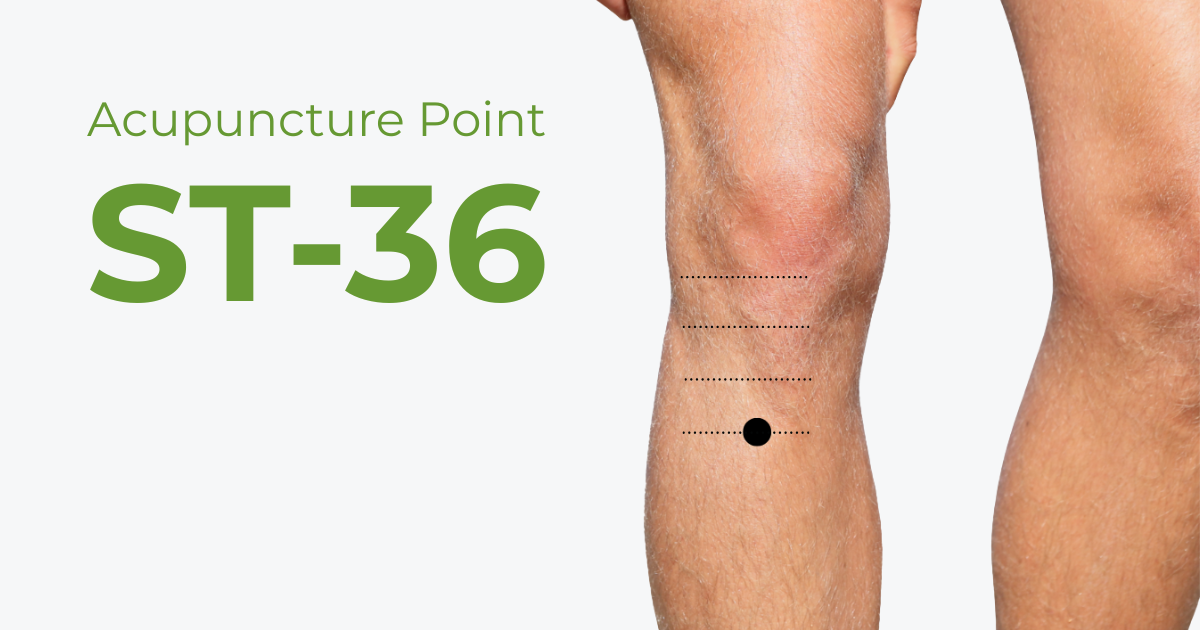
The textbook approach. ST36 sits 3 cun inferior to ST35 (the lateral eye of the knee or the tibiofemoral joint line), one finger-breadth lateral to the anterior tibial crest. Cun measurement is a solid starting point, especially for learning, but it has limitations — finger widths vary dramatically between practitioners and patients, and finding the correct ST35 can be tricky in itself. This is definitely where I recommend new students start, as it will set you up well for Method 3.
Method 2: The Hand-Check Method
A useful cross-reference technique that many practitioners use as a quick confirmation. Place the patient’s own hand (four fingers) starting at the ST35 location — just below where the pinky finger lands, one finger-breadth lateral to the crest of the tibia, will get you very close to ST36. It’s a cheat method, but it gives you a fast proportional measurement to work with. Good for a quick check to make sure your location isn’t way off.
Method 3: The Palpation Method
This is the one I trust most, but it’s more advanced and requires a lot of practice with Method 1 first. If you carefully run your finger up the lateral side of the tibia, you’ll notice the bone will start to push you slightly laterally as you approach the point. Just as you feel that lateral push, stop — this should be right at ST36. Anatomical palpation turns point location from guesswork into a clinical skill, so get comfortable palpating for these small nuances in your patient’s anatomy.
A note on the finger-breadth: The “one finger-breadth lateral to the tibial crest” instruction sounds simple, but whose finger? On a large patient with a thick tibia, one finger-breadth measured by the practitioner can land you medially onto the bone itself. Learn to palpate, and you won’t need to rely on measurement alone.
Want to see all three methods demonstrated? I break down each one in detail — including which method I don’t fully trust — in this video: 3 Location Techniques for ST36 →
Nearby Structures
- Tibialis anterior muscle — ST36 typically lies on this muscle belly
- Deep peroneal nerve — key to the Western mechanism of this point (more on this below)
- Anterior tibial artery — runs nearby; depth awareness matters
- Extensor digitorum longus — lateral neighbour
If you’re not confident in your surface anatomy around the anterior compartment of the leg, this is exactly the kind of point where anatomical palpation training pays off.
The Western Science of ST36
Why does this point do so much? Western research has been trying to answer that for decades, and the findings are genuinely impressive.
Neurological mechanism: ST36 stimulates the deep peroneal nerve, which is a branch of the common fibular (peroneal) nerve. This triggers afferent nerve signals that travel up the spinal cord and influence both the enteric nervous system (the gut’s own nervous system) and the central nervous system. That’s a big part of why this point has such a strong effect on digestion — it’s essentially communicating directly with the gut via the nervous system.
Immune modulation: This is where ST36 gets genuinely fascinating from a Western perspective. Multiple studies have demonstrated that needling ST36 increases white blood cell activity, stimulates natural killer cell production, and modulates inflammatory cytokines. The research on ST36 and immune function is some of the strongest evidence base we have for any acupuncture point — and it explains why classical Chinese medicine considered this point essential for building Wei Qi (defensive energy).
Endogenous opioids: Like LI4, needling ST36 has been shown to stimulate the release of endogenous opioids — the body’s own natural pain-relieving compounds. This contributes to its well-documented analgesic effect and explains why it’s useful far beyond just digestive complaints.
Vagal nerve influence: Emerging research suggests ST36 may exert some of its effects via the vagus nerve, particularly for its anti-inflammatory and digestive actions. This is an active area of research.
The TCM Perspective
ST36 is the He-Sea point of the Stomach channel, which means it’s where the channel’s Qi “dives deep” — into the organs themselves. He-Sea points are classically indicated for disorders of the fu organs (hollow organs), which is why ST36 is so powerful for digestive issues.
It’s also the Earth point on an Earth channel — double Earth energy, which is why it’s considered one of the most tonifying points in the entire system.
Classical Actions:
- Tonifies Stomach and Spleen Qi
- Resolves Dampness and Food Stagnation
- Tonifies Qi and Blood (especially post-illness or deficiency)
- Strengthens Wei Qi (immune defence)
- Raises Yang and lifts prolapse
- Calms the Shen (mind) — often overlooked
- Benefits the lower limbs
- Harmonizes the Middle Jiao
Classical Indications:
- Digestive disorders of all kinds: nausea, vomiting, bloating, diarrhea, constipation, epigastric pain
- Fatigue and general deficiency
- Immune deficiency — frequent illness, slow recovery
- Prolapse of any organ
- Knee pain and lower limb weakness
- Mental-emotional complaints: anxiety, poor memory, over-thinking (the Spleen’s emotional domain)
- Post-operative recovery and chemotherapy support
Clinical Pearls from 25 Years
I’ve needled ST36 more times than I can count — and I still see the same three mistakes come up again and again in new graduates. Let’s fix them.
Problem 1: Moving the Leg During Location
Pick a position and stay there. This sounds obvious, but here’s what actually happens in clinic: a student locates ST36 with the knee bent, marks the spot, then extends the leg to needle — and now they’re in the wrong place. The soft tissue shifts when the leg position changes, and ST36 moves with it.
The rule: decide whether the leg is bent or straight before you locate the point, and don’t change it. I prefer a slightly flexed knee with a bolster underneath — it relaxes the tibialis anterior and makes palpation cleaner. But whatever position you choose, lock it in and keep it there from location through to needle insertion.
Problem 2: Going Too Far Lateral with the “Finger-Breadth” Method
This is probably the most common location error I see, and it’s baked right into how the point is taught. “One finger-breadth lateral to the anterior tibial crest” — fine in theory, but in practice, many practitioners end up too far lateral, sliding off the Stomach meridian entirely.
This is exactly why I teach that both palpation and cun measuring are necessary skills to develop together. Use cun measurements as your starting point, but train your palpation skills to ensure you land on the right point every time.
Problem 3: Not Warning Patients About Needle Sensation
This is the one I see new graduates skip most often, and it matters more with ST36 than almost any other point.
When ST36 is needled correctly, the sensation is memorable. Deep, achey, sometimes radiating down the leg toward the foot. To a first-time patient, this can feel alarming — especially if the other points in the treatment felt like nothing at all.
Before you needle ST36, say something like: “This point sometimes creates a deeper, achey sensation compared to other points — that’s completely normal and it’s actually what we’re looking for. If you feel sharp or pinching, let me know.”
The response you want from your patient? “Weird.” That’s the one. Weird means De Qi. Weird means you’re in the right place. Sharp and pinching that lasts more than 30 seconds means something needs to adjust.
Don’t skip this conversation. A startled patient becomes a patient who doesn’t return.
Want to see all three of these problems demonstrated? 3 Common Problems with ST36 →
4. Don’t Neglect It for Mental-Emotional Cases
ST36 is so associated with digestion that practitioners sometimes forget its Shen-calming properties. The Stomach channel runs to the head — and excessive thinking, worry, and overthinking are Spleen/Stomach patterns. In patients with anxiety driven by over-thinking or digestive stress, ST36 can be surprisingly effective as part of a mental-emotional treatment.
5. Depth Awareness
Needle perpendicularly, 1–2 cun. The depth depends on the patient’s build. You want to feel the needle in the muscle belly of tibialis anterior — not too close to bone. If a patient reports a sharp, hard sensation immediately on insertion, you may be too medial. Adjust laterally and re-insert. However, the common mistake is for students to needle too far laterally along the Gall Bladder meridian.
Interesting and Unexpected Applications
Chemotherapy support: ST36 is one of the most researched acupuncture points in oncology settings, specifically for chemotherapy-induced nausea, fatigue, and immune suppression. If you work with cancer patients, this point is essential.
Post-surgical recovery: Classically used to build Qi and Blood after major illness or surgery. The immune-modulating and tonifying properties make it a go-to during recovery phases.
Prolapse: ST36 raises Yang Qi, making it a key point in prolapse presentations — gastric prolapse, uterine prolapse, rectal prolapse. Often combined with GV20 and CV6 for this purpose.
Pediatric applications: In children, ST36 is often used without needles — through pediatric tuina or acupressure — as a foundational tonifying and immune-building point. It’s one of the most commonly used points in Chinese pediatric medicine.
Longevity point: In classical Chinese medicine, ST36 was considered a longevity point — regular moxibustion on ST36 was used to maintain health and vitality throughout life. The Japanese tradition of okyu (rice-grain moxa) frequently targets this point. This isn’t just historical romanticism — the immune-modulating research gives it modern credibility.
Knowing why these combinations work — not just which points to pair — is what separates pattern-based prescribing from point-recipe prescribing. If point selection is something you want to sharpen, that’s exactly what my Point Selection Course is built around.
Contraindications and Cautions
- Excess conditions: ST36 is primarily a tonifying point. In acute excess patterns (high fever, acute infection), using tonifying technique on ST36 may not be appropriate — or at minimum, choose reducing technique.
- Skin conditions: Avoid needling through compromised skin, active rashes, or varicose veins in the area.
- Depth in thin patients: In very lean patients, 1 cun may be sufficient. The anterior tibial artery runs nearby — maintain awareness of depth.
ST36 is Powerful — but the Full Top 10 Will Transform Your Practice
Download the complete Top 10 Acupuncture Points guide — clinical profiles, key combinations, location tips, and a bonus Back-Shu chart. Everything you need in one place, instantly.
Yes, Send Me the Top 10 Points — Free →100% free — no spam, unsubscribe anytime