


If ST36 is the point that “treats all diseases”, SP6 is not too far behind – I use this point perhaps more than any other.
Sanyinjiao. Three Yin Meeting. It’s the meeting point of three leg channels — Spleen, Liver, and Kidney — which is exactly why it shows up in so many different treatment protocols. Gynaecological conditions, digestive issues, sleep disorders, urinary problems, emotional complaints — SP6 has a role in all of them.

And here’s something that might surprise you: Western medicine has been using SP6 for decades. They just don’t call it acupuncture (even though they use acupuncture needles).
More on that in a moment. First, let’s make sure you know exactly where to find it.
Anatomy: How to Actually Find This Point
SP6 sits on the medial aspect of the lower leg, and getting it right requires a clear understanding of the landmarks you’re working with.
Starting point: the tip of the medial malleolus (the inner ankle bone – see Step #1 below). Measure 3 cun directly superior from here — that’s approximately four of the patient’s own finger-widths stacked above the tip of the ankle bone (similar “cheat method” used to locate ST36). The point lies just posterior to (behind) the medial crest of the tibia. That’s the quick way to find SP6 – not my favourite way (see video below).
However, if you want to be super accurate (and you should be), you’ll need to first locate the tip of the medial malleolus and then another anatomical landmark — the acupuncture point SP9 — which is just inferior to the medial condyle of the tibia. It is between those two landmarks (SP9 and medial malleolus tip) which gives you 13 cun. Now 13 cun is an odd number to work with, so listen carefully: divide that 13 cun in half (to 6.5), come down another 0.5 cun (so you have 6), and simply divide 6 in half — and you get 3 cun above the malleolus. Practice that method as many times as possible before you completely rely on the cheat method mentioned above. Use your cun measurements when they are available.
*If you’re already confused because you think this distance should be 15 cun – you’re making one of the most common mistakes that students make when measuring the medial side of the leg. I clarify everything with this video below – it is a must watch! It also includes my favourite way to find SP-6

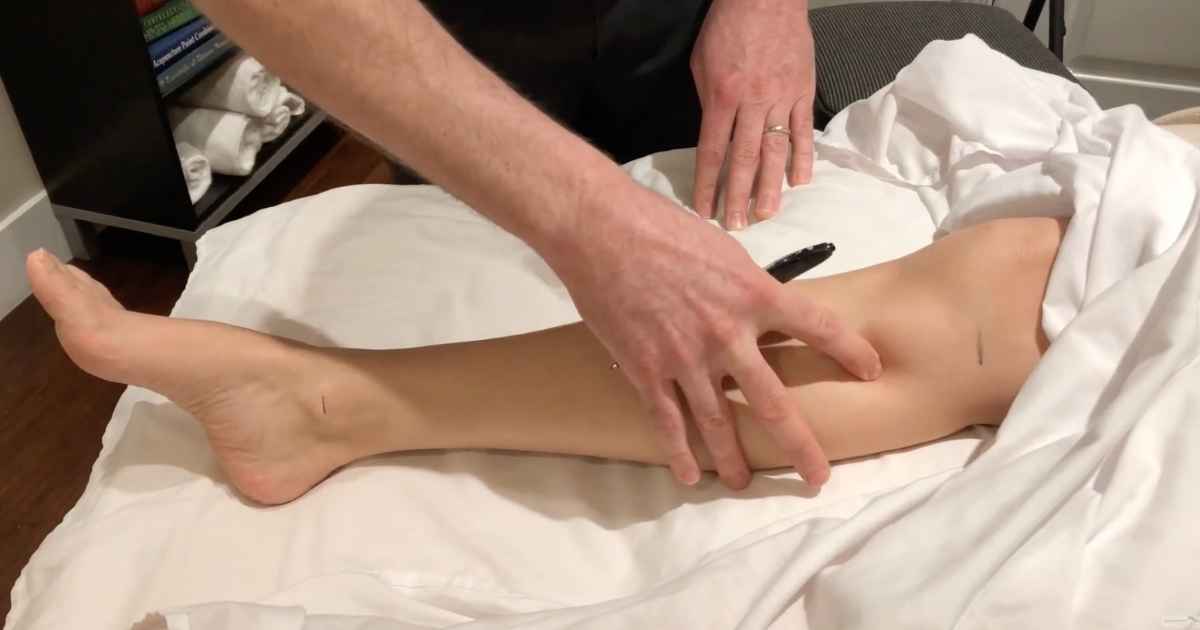
Palpation tip: run your finger up the medial border of the tibia to the condyle of the tibia and notice the way the condyle pushes you medially — that is how you land on SP9 (see Step #2 below). It requires practice to feel for this, so work on this important palpation skill. Finding the tip (the highest point) of the medial malleolus is easy, but just be sure it is the peak of the bone when you are done.
Patient positioning: SP6 is best located and needled with the patient supine and the knee slightly externally rotated — a small pillow or bolster under the knee works well. Prone needling is definitely doable but can be tricky as you can’t see your landmarks as easily. Work on both positions, as SP6 is going to come up a lot in point prescriptions.
Nearby Structures
- Flexor digitorum longus — the muscle belly SP6 sits within
- Posterior tibial nerve — the key structure for Western mechanism (see below)
- Posterior tibial artery — runs in this region; be depth-aware
- Great saphenous vein — medial leg; avoid varicosities
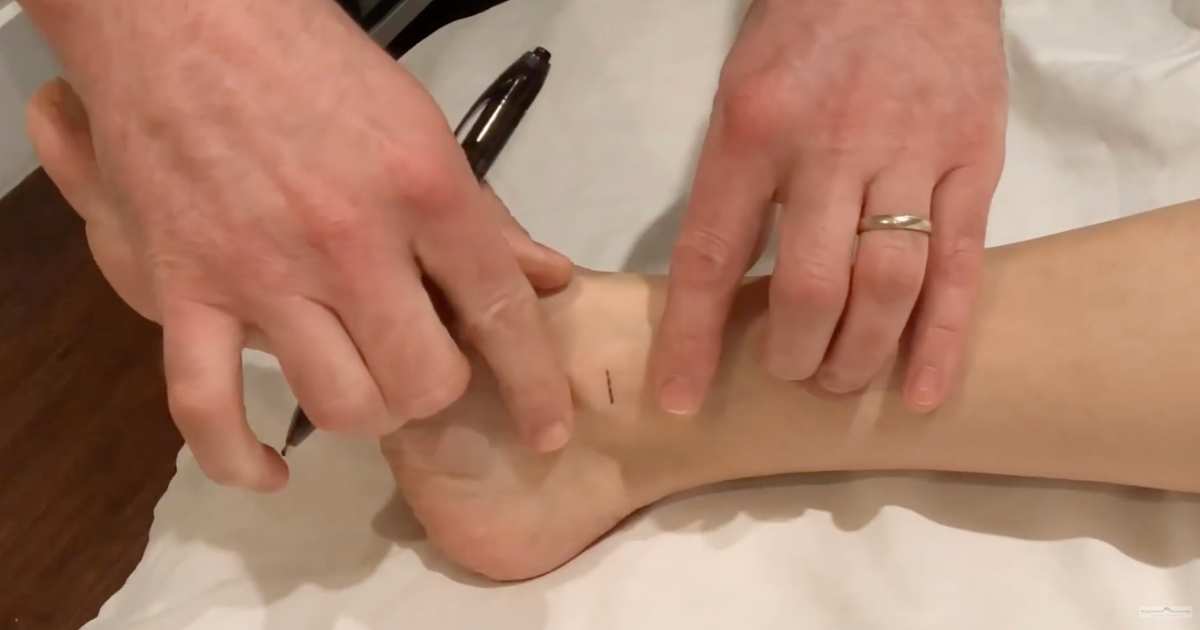
Step #1 – Locate the very tip of the medial malleolus (the most prominent aspect of the ankle bone)
Step #2 – Find the lower aspect of the medial condyle of the tibia. Run your finger up the medial side of the tibia until you feel the bone pushing you medially – stop there.
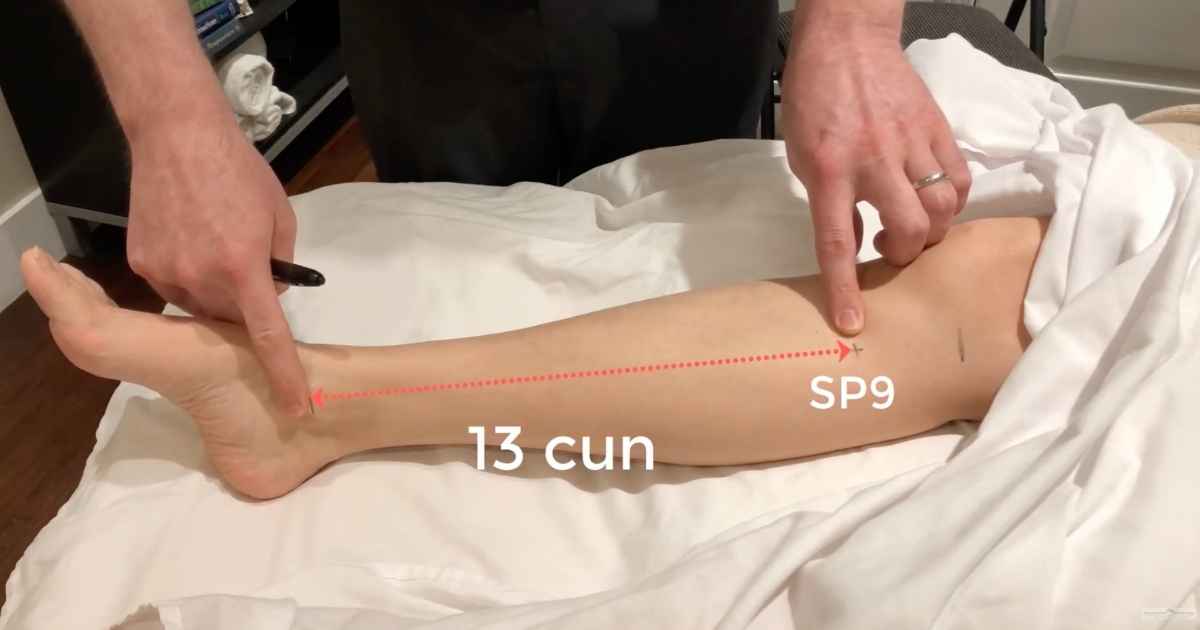
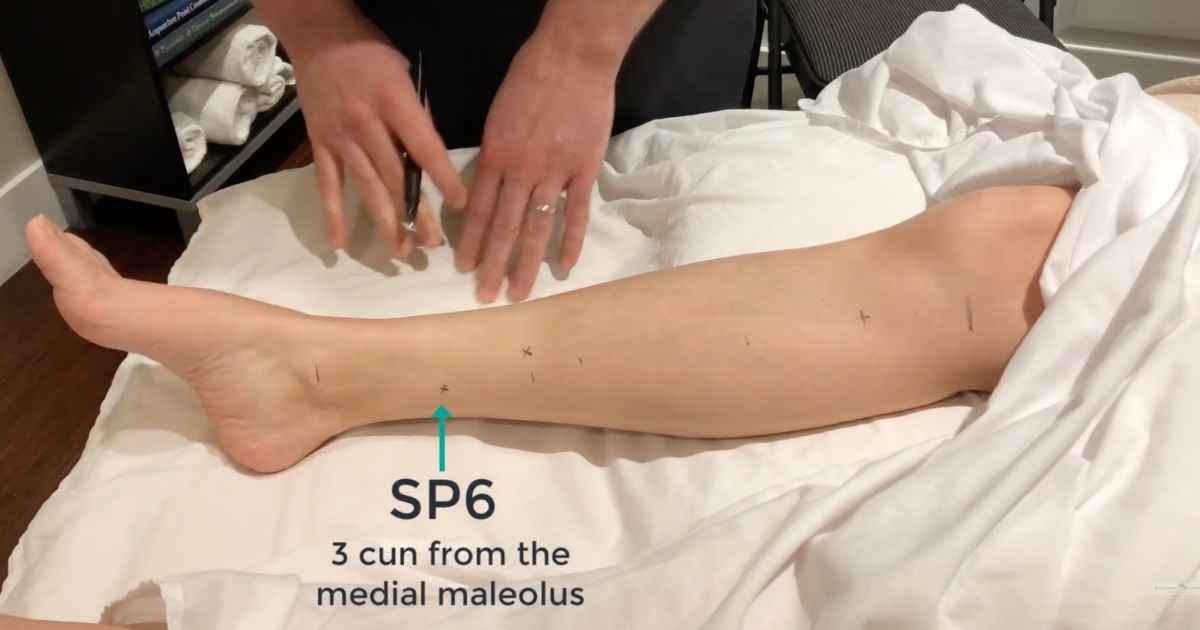
Step #3 – Once you have the two anatomical endpoints (the tip of the malleolus and the lower aspect of the medial condyle), this distance is 13 cun.
Step #4 – To locate SP-6, divide 13 cun in half (giving you 6.5). To get to 6 cun, simply bring your finger down 0.5 cun (about half an inch). This makes it very easy to find your 3 cun above the malleolus, which is where SP-6 is located.

The Western Science of SP6
This is where it gets genuinely fascinating — and where SP6 earns its reputation beyond TCM circles.
The posterior tibial nerve: SP6 directly stimulates the posterior tibial nerve, a branch of the sciatic nerve that innervates the medial leg, foot, and — critically — the pelvic floor and lower urogenital region. This is why SP6 has such a powerful effect on both gynaecological and urinary conditions. The nerve pathway provides a direct neurological line from the lower leg to the pelvis.
Dysmenorrhea research: The research on SP6 for painful periods is some of the strongest we have for any acupuncture point in gynaecology. Multiple RCTs have demonstrated that acupuncture at SP6 significantly reduces menstrual pain, with effects comparable to NSAIDs in some studies — and without the side effects. The mechanism involves both endorphin release and modulation of prostaglandin levels, which are the primary drivers of menstrual cramping.
Uterine blood flow: Studies using Doppler imaging have shown that needling SP6 increases blood flow to the uterus — directly relevant to stagnation-type dysmenorrhea and some fertility presentations.
Sleep and serotonin: Research has shown SP6 stimulation influences serotonin levels, which connects its classical use for insomnia to a clear neurochemical mechanism.
Western Medicine Is Already Using This Point
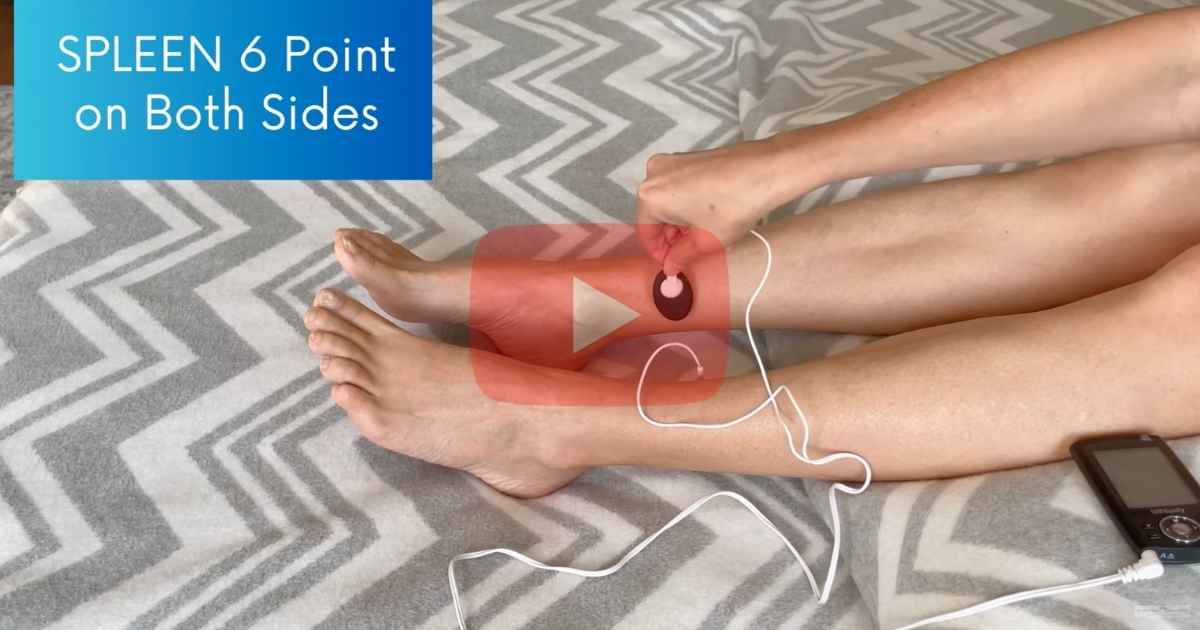
Here’s something worth telling your patients and your colleagues: urologists have been stimulating SP6 for years to treat overactive bladder (OAB) and urinary incontinence. They call it Percutaneous Tibial Nerve Stimulation (PTNS). Click the link above to see an MD perform this procedure.
The procedure involves inserting a fine needle (yes, an acupuncture needle) — right in the SP6 region — and applying electrical stimulation to the posterior tibial nerve. The nerve signal travels up to the sacral plexus and modulates bladder function.
Sound familiar? It should. That’s acupuncture with an electro unit, approved by the FDA and billed through urology clinics.
This isn’t a criticism of Western medicine — it’s actually validation. When urologists independently arrive at the same anatomical target that TCM identified thousands of years ago, that’s a meaningful convergence. And it’s a powerful conversation to have with skeptical patients or referring physicians.
Want to see the PTNS done by an MD, along with how to apply TENS at SP6 for dysmenorrhea? Click on the video →
The TCM Perspective
SP6 is classified as the meeting point of the three Yin channels of the leg — Spleen, Liver, and Kidney. This is why its clinical reach is so broad. When you needle SP6, you’re not just affecting the Spleen channel — you’re simultaneously influencing all three organ systems.
- Spleen: digestion, transformation of Dampness, Blood production
- Liver: smooth flow of Qi, Blood storage, menstruation, emotional regulation
- Kidney: reproductive essence, Yin and Yang foundation, urinary function
That three-channel intersection is the reason SP6 appears in treatment protocols for almost every gynaecological pattern in TCM.
Classical Actions:
- Strengthens the Spleen and resolves Dampness
- Nourishes Blood and Yin
- Regulates the Liver and moves Qi and Blood
- Tonifies the Kidney
- Regulates menstruation and relieves dysmenorrhea
- Calms the Shen (mind) and promotes sleep
- Promotes urination and resolves Damp-Heat in the lower jiao
- Invigorates Blood and dispels stasis
- Harmonizes the Lower Jiao
Classical Indications:
- Dysmenorrhea, irregular menstruation, amenorrhea, PMS
- Uterine prolapse, leucorrhoea
- Digestive disorders: bloating, diarrhea, poor appetite
- Insomnia and anxiety
- Urinary disorders: retention, incontinence, UTIs
- Oedema of the lower limbs
- Skin conditions (Damp-Heat patterns)
- Fatigue and Yin deficiency
- Male reproductive issues: impotence, premature ejaculation
- Fertility support
Clinical Pearls from 25 Years in Practice
1. SP6 for Dysmenorrhea — Timing Is Everything
SP6 is arguably the most important acupuncture point for dysmenorrhea, but when you use it matters as much as the fact that you use it. Treating during the acute pain phase is helpful, but beginning treatment 5–7 days before the expected onset of menstruation produces significantly better results.
Think of it this way in TCM terms: you’re moving Qi and Blood before they have a chance to stagnate. Once cramping has already set in, you’re managing a stagnation that’s already established. Prevention is easier than cure — and in this case, prevention means treating in the week before.
2. TENS at SP6 for Dysmenorrhea
For patients with severe dysmenorrhea, electro-acupuncture or a TENS unit applied at SP6 is one of the most effective interventions you can offer — and it gives patients a home-care tool they can use themselves.
Key TENS parameters for SP6/dysmenorrhea:
- Frequency: 2–4 Hz (low frequency — this drives endorphin release)
- Intensity: strong but comfortable — the patient should feel a clear, pulsing sensation without pain
- Duration: 20–30 minutes per session
- Timing: begin 1–2 days before expected onset; continue through the first 1–2 days of menstruation
A TENS unit placed at SP6 gives patients control between clinic visits and dramatically improves compliance and outcomes. It’s one of the best self-care recommendations you can make for this patient population. See the video above for a full demonstration of this technique.
3. Don’t Go Too Superior
The most common location error with SP6 is drifting too far superiorly — this is especially common with students who are not comfortable with anatomical palpation and often mis-locate the SP9 landmark or even use the malleolus incorrectly. Work on your palpation skills and use those cun measurements once you have your landmarks in place.
4. SP6 Is Strongly Contraindicated in Pregnancy
This is non-negotiable. SP6’s powerful action on the uterus — the same mechanism that makes it so effective for dysmenorrhea — makes it potentially dangerous during pregnancy. SP6 is one of the most strongly contraindicated points in all of obstetric acupuncture. This includes acupressure. If your patient is pregnant or trying to conceive, confirm before you needle the lower leg.
Interestingly, SP6 is sometimes intentionally used in late pregnancy to encourage labour onset — but only under appropriate clinical supervision and never without clear obstetric indication.
5. SP6 + Insomnia
This is an application many new practitioners overlook. SP6 nourishes Yin and Blood, calms the Shen, and — based on the serotonin research — has a clear neurochemical basis for improving sleep. Combined with HT7, it’s one of the most effective pairings in the system for insomnia with a Yin deficiency or Blood deficiency pattern. Don’t reserve SP6 only for gynaecological cases.
Interesting and Unexpected Applications
Urinary incontinence and OAB: As discussed above, the PTNS protocol used by urologists for bladder control is essentially SP6 stimulation. If you have patients with overactive bladder or stress incontinence, SP6 — especially with electrical stimulation — is worth including in your treatment.
Fertility support: SP6 is one of the core points in fertility acupuncture protocols. It supports Kidney Yin and Essence, regulates the Chong and Ren vessels, and improves uterine blood flow. Whether treating directly for fertility or supporting IVF cycles, SP6 is almost always in the protocol.
Labour induction: In the final weeks of pregnancy (38+ weeks), SP6 is used — carefully and with appropriate oversight — to help ripen the cervix and encourage the onset of labour. The same moving and descending action that makes it contraindicated in early pregnancy becomes therapeutically useful at term.
Male reproductive health: SP6 is frequently overlooked in male patients, but its Kidney-tonifying and Damp-resolving actions make it valuable for impotence, premature ejaculation, and prostatitis. Don’t limit it to female patients.
Skin conditions: SP6’s ability to resolve Dampness and nourish Blood gives it a role in chronic skin conditions — particularly eczema, urticaria, and other Damp-Heat or Blood deficiency patterns. It pairs well with SP10 (Xuehai) for Blood-level skin conditions.
SP6 and LI4 together form one of the most powerful Qi and Blood moving combinations in the system — extremely effective for stagnation-type dysmenorrhea, but absolutely contraindicated during pregnancy for exactly that reason.
If you want to go deeper into point selection for dysmenorrhea — including which combinations work best for each TCM pattern — that’s exactly what my TCM Treatment of Dysmenorrhea course covers in full.
Contraindications and Cautions
- Pregnancy: SP6 is strongly contraindicated during pregnancy. Its descending, moving action on the uterus makes it potentially abortifacient, particularly in the first trimester. This applies to both needling and acupressure. The only exception is intentional use for labour induction at full term under appropriate clinical supervision.
- Late-stage deficiency: In patients with severe Qi or Blood deficiency, use light stimulation. Aggressive moving technique when there’s nothing to move can exhaust the patient further.
- Depth awareness: The posterior tibial artery is in the vicinity. Standard perpendicular needling of 1–1.5 cun is appropriate for most patients; avoid excessive depth, and if a nerve sensation is noticed by your patient, do not continue stimulating.
Ready to Treat Dysmenorrhea With Confidence?
SP6 is just the start. My TCM Treatment of Dysmenorrhea course covers every diagnosis, the best acupuncture point protocols, herbal formulas, electro-acupuncture settings, and a full sample case — everything you need to help the 90% of menstruating patients who deal with painful periods.
Yes, I Want to Treat Painful Periods Better →$87 · Lifetime access · 30-day money-back guarantee
You just learned how to find SP6 precisely. Want the same clarity for the other 9 must-know points? Get the free Top 10 guide + bonus Back-Shu chart →