
From headaches, neck stiffness, eye strain, tinnitus — GB20 shows up in the treatment plan for all of them, often as the point that actually changes the outcome.
Fengchi. Wind Pool. In TCM, “Wind” is the pathogenic factor most associated with headaches and dizziness, but also with the sudden, migratory quality behind many eye and ear complaints — think sudden tinnitus, blurred vision, or a stiff neck that seems to appear overnight. GB20 sits at the exact spot where External Wind is said to enter the body through the neck, which is precisely why it’s been the go-to point for head, neck, eye, and ear complaints for centuries — not just headaches.
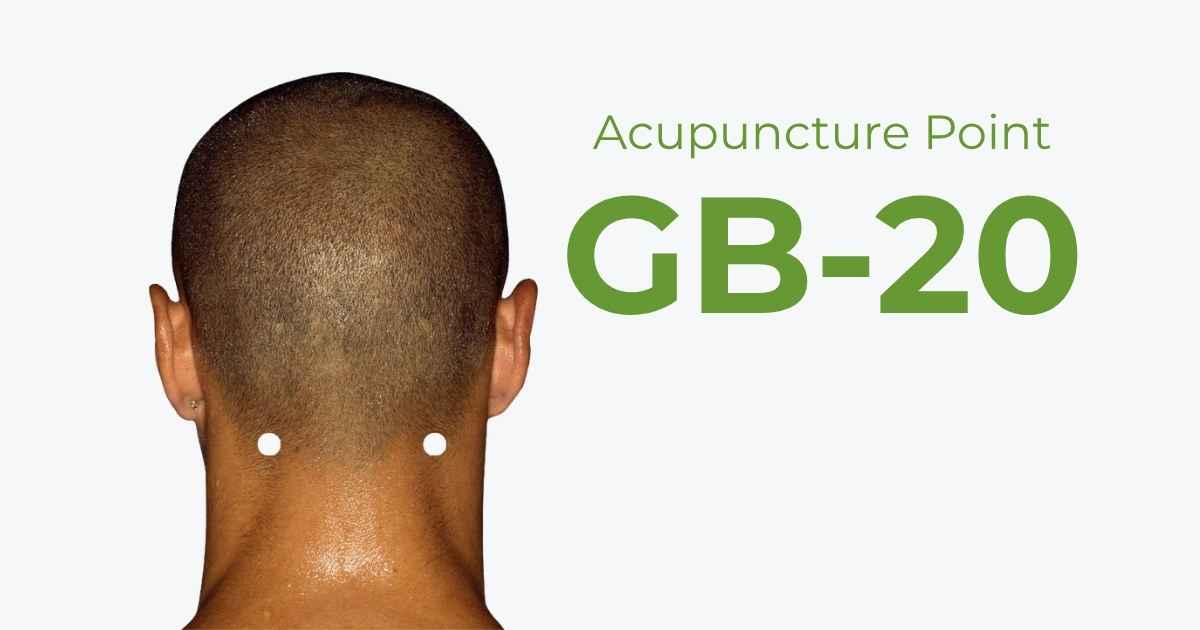
Let’s take a quick look at the main details for GB-20.
| Point Name | Fengchi — "Wind Pool" |
| Channel | Gallbladder (Foot Shaoyang) |
| Point Number | GB20 |
| Point Type | Meeting point of the Gallbladder channel and the Yang Wei Mai (Yang Linking Vessel) |
| Element | Wood (Gallbladder is paired with Liver) |
| Location | At the base of the skull, in the depression between trapezius and sternocleidomastoid |
Anatomy: How to Actually Find This Point
GB20 is a bilateral point at the base of the skull, and precision here matters more than with almost any other point you’ll use regularly — a centimeter off in either direction or an inappropriate needle angle changes which point you’re on – and which important anatomy is underneath.
Starting point: have the patient lying face down with their head slightly flexed forward (use a face cradle). Locate the base of the occiput (base of the skull), then run your finger laterally along the base of the skull until you feel the depression between two muscle groups — the trapezius (medially) and sternocleidomastoid (laterally). GB20 sits in that depression. One tip I talk about in my Anatomical Palpation Course is to get your patient to lift their head out of the face just an inch – this will engage the trapezius muscles and will show you right where that depression is for GB20.
The landmark that matters most: you’re feeling for a genuine depression, not just soft tissue. If you’re pressing into solid muscle belly rather than a hollow, you’re either too medial (on the trapezius) or too lateral (on the SCM insertion). The correct point often has a distinctly different “give” under your finger compared to the tissue immediately around it. Not only that, the deep ache that can come with simple acupressure on this spot is another way to indicate you are in the exact spot. This sensation often refers to the front of the forehead if you are in the right spot.
Patient positioning: as with most needling situations, I encourage a lying down position. Face down (prone) is really the only option here. Just make sure their head is in a state of anterior flexion before you needle this point – it allows for a much simple needling situation for you and prevents less needle angulation errors.
Nearby structures: greater occipital nerve (the key structure for Western mechanism — see below), vertebral artery (deeper and more medial — depth and angle awareness matters here), suboccipital muscle group, trapezius and sternocleidomastoid insertions.
The Western Science of GB20
GB20’s anatomical position isn’t incidental — it sits almost directly over one of the most clinically significant nerves in headache medicine.
The greater occipital nerve: GB20 is located close to the emergence point of the greater occipital nerve, which is directly implicated in occipital neuralgia, cervicogenic headache, and tension-type headache. This is the same nerve targeted in occipital nerve block injections performed by neurologists and pain specialists — GB20 needling and the medical occipital nerve block target overlapping territory.
Suboccipital muscle release: The suboccipital muscles (which GB20 sits directly over) are frequently implicated in tension headaches through sustained contraction and trigger point formation. Needling or sustained pressure at GB20 has a direct myofascial release effect on this muscle group, independent of any purely neurological mechanism.
Vertebrobasilar circulation: Some research has explored GB20’s effect on vertebral artery blood flow via Doppler studies, which may partly explain its classical use for dizziness and vertigo — though this research base is smaller and less definitive than the neurological mechanism above.
Migraine research: Multiple trials on acupuncture for migraine prophylaxis include GB20 as a core point in the treatment protocol, with several showing effect sizes comparable to standard pharmacological migraine prevention — without the medication side-effect profile.
The TCM Perspective
GB20 is a meeting point of the Gallbladder channel with the Yang Wei Mai (Yang Linking Vessel) and the Yang qiao/several other yang channels converging at the neck and head — which is exactly why it has such broad reach across headache types, not just one presentation.
Its location at the base of the skull makes it the classical entry point for External Wind — whether Wind-Cold, Wind-Heat, or Wind alone. This is also why GB20 shows up constantly in early-stage common cold treatment, not just chronic headache management.
Gallbladder channel: governs decision-making, the sinews, and — critically for headaches — runs directly along the sides of the head, making it the primary channel for temporal and lateral headache patterns including ear related issues.
Classical Actions:
- Expels Wind (both External and Internal/Liver Wind)
- Clears the head and benefits the sense organs (eyes, ears, nose)
- Subdues Liver Yang rising
- Benefits the neck and relieves stiffness
- Clears Heat
Classical Indications:
- Headache — nearly all types, but especially occipital, temporal, and Wind-pattern headaches
- Dizziness, vertigo
- Neck stiffness and pain, whiplash-type presentations
- Common cold, early-stage external invasion, stuffed nose
- Eye conditions — redness, pain, blurred vision
- Hypertension with Liver Yang rising signs (dizziness, headache, irritability)
- Tinnitus
Clinical Pearls from 25 Years in Practice
1. GB20 Is Not Optional for Headache Patients — It’s Foundational
New practitioners sometimes treat GB20 as one option among many for headache. In my experience, it belongs in nearly every headache prescription regardless of the specific pattern — the only real question is what you combine it with, not whether you include it.
2. Match Your Angle to the Concern
Angling the needle slightly toward the opposite eye tends to work well for frontal or eye related concerns; angling more directly toward the nose can be more effective for nose related concners. Small adjustments here make a real clinical difference — don’t just needle straight in the same way every time.
More importantly, watch your needle angle – it’s very easy to get this wrong when people’s heads are in the face cradle. It can be hard to see where their eyes and noses are when they are face down on the table. Try this the next time you needle this point…needle both points and then carefully extrapolate where the needles are pointing and see where they end up. Most students tend to angle things far too superiorly. Get right down on the floor for this exercise and see where your needles are pointing and see how close you are (or aren’t) to your intended target.
3. Don’t Underestimate the Myofascial Component
Especially with computer-related tension headaches, spend extra time on sustained pressure or gentle circular massage at GB20 before needling — releasing the suboccipital muscle tension manually often improves the response to the needle itself. Patient positioning is paramount – make sure they are relaxed and comfortable in the position they will be in for the next 30 minutes.
4. GB20 + GB21 Is Your Stress-Headache Combination
For the extremely common “stress lives in my neck and shoulders” presentation, GB20 paired with GB21 addresses both the head and the shoulder tension simultaneously — one of my most frequently used combinations in a modern desk-job clinic population. See my article on GB-21 here.

See if GB20 Made the Top 10 Points Every Practitioner Needs to Know
A free guide to all 10 essential points: clinical actions, key combinations and location tips for each, plus a bonus Back-Shu points chart.
Send Me the Free Guide →100% free — no spam, unsubscribe anytime
| Combination | Clinical Indication |
| GB20 + GB21 | Stress-driven tension headache with neck and shoulder tightness |
| GB20 + LV3 | Liver Yang rising headache — dizziness, irritability, hypertension |
| GB20 + Taiyang | Temporal/one-sided migraine pattern |
| GB20 + Yintang | Frontal headache, calms the mind for migraine with anterior involvement |
| GB20 + LI4 | Common headache combination — general pain relief, external Wind invasion |
| GB20 + GV16 | Occipital headache, stiff neck, early-stage Wind invasion |
| GB20 + BL10 | Cervicogenic headache and neck stiffness |
| GB20 + SI3 | Neck and upper back tension combination |
GB20 and GB21 together form one of the most reached-for combinations in a modern clinical practice — between screen-driven tension headaches and shoulder tension, this pairing addresses the two most common complaints walking through the door on any given day.
Contraindications and Cautions
- Depth and angle: The vertebral artery runs deeper and more medially in this region. Standard practice is to angle the needle toward the tip of the nose or the opposite eye rather than straight anteriorly toward the throat — avoid deep, straight-in perpendicular needling at this location.
- Elderly patients and osteoporosis: Use additional caution with elderly patients or those with cervical spine fragility; gentler technique and shallower depth are appropriate.
- Hypertensive patients: While GB20 is classically used for Liver Yang rising presentations that often accompany hypertension, always be mindful of a patient’s current blood pressure status and any dizziness that could indicate something requiring medical follow-up rather than acupuncture alone.
What does GB20 do in acupuncture?
Where exactly is GB20 located?
Why is GB20 called "Wind Pool"?
Is GB20 good for migraines?
Can GB20 help with dizziness?
Is GB20 safe to needle?
Can you use GB20 as acupressure at home?
What is GB20 best combined with?
Ready to Palpate With Total Confidence?
Finding a point like GB20 accurately — every time, on every patient — comes down to one skill: palpation. My Anatomical Palpation Mastery course trains you to locate every major landmark and point with precision, so you're never guessing in clinic again.
Yes! I'm Ready to Master My Anatomical Palpation Skills!$197 · Lifetime access · 30-day money-back guarantee